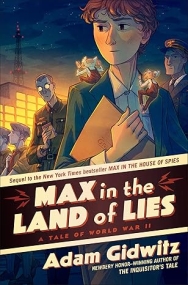
Max in the Land of Lies: A Tale of World War II (Operation Kinderspion)

 
4.7 (2)
 
0.0 (0)
534 0
91zO7y76FyL
Author(s)
Age Range
8+
Release Date
February 25, 2025
ISBN
978-0593112113
Buy This Book
     
Max Bretzfeld is back in Berlin—as a British spy. His most dangerous mission is about to begin in the much-anticipated sequel to Adam Gidwitz’s instant bestseller Max in the House of Spies.

Max is on a mission.

Well, two missions.

One has been assigned by his British spymasters: Infiltrate the Funkhaus, the center of Nazi radio and propaganda.

The other they have forbidden: Find his parents.

Max Bretzfeld was willing to do anything to return to Germany, even become a British spy. Training complete and forged papers in hand, the radio wunderkind’s missions have begun. But nothing is as he expected. His parents are missing. Nazi intelligence is watching him. And the lines between lies and truth are becoming more blurred every day.

Editor reviews

2 reviews
Lasting Impact towards Understanding Nazi Germany
(Updated: July 10, 2026)
Overall rating
 
4.7
Plot
 
4.0
Characters
 
5.0
Writing Style
 
5.0
Illustrations/Photos (if applicable)
 
N/A
Max in the Land of Lies is the conclusion to the duology by Adam Gidwitz. In the first book, we met Max Bretzfeld as his parents found him safe passage out of Germany just as things were going from bad to deadly for the Jewish people in World War II under Hitler’s leadership. In his English home, Max convinces the family to let him train for a spy mission back in Germany.
This story is the continuation of Max’s harrowing adventures as a spy behind enemy lines in Germany. This is not traditional historical fiction because the author has introduced two magical creatures, Berg and Stein, to sit invisibly on Max’s shoulders. Their presence serves several purposes. The first is that they lighten the tone of a book centered around the horrors of a country full of Nazism, making it suitable for Middle-Grade readers. The other is that Max is portrayed as very clever and able to pull off long pranks to avenge himself against bullies and antisemites. Gidwitz does not have Max use much inner dialogue with readers, and as a spy, he must keep his own counsel, so Berg and Stein allow us to question Max’s actions and be astounded by his cleverness. Third is that they bear witness along with the reader about life in Nazi Germany.
I really like that at the end of the story, the author takes the time to break down how much of the story is real and where he deviated, showing us that not much is actually fiction. Another incredibly poignant decision he made in crafting this tale was humanizing the German people. He explains that for years in books and movies, Nazi’s are the big bad, the easy villains, or oafish buffoons destined to lose because they are monsters. Gidwitz examines, through Max’s interactions, many reasons why people stayed in Germany or supported the Nazis. Some out of fear, power, sense of pride, community, propaganda, income, school’s curriculum, government incentives, bad economy, apathy, because it didn’t affect them. There are as many reasons as there are people, and that is especially impactful given the close parallels to events of today’s time. Seeing a population learn how to act monstrously strikes the need to be vigilant in our own times.
I also like that Gidwitz examined the mindset of the English as well. They are not given the hero worship treatment, but their underbelly was shown, too. Through Max, we see the causal cruelty and ill will toward Jewish people. Higher up government officials who were hearing about the horrors of concentration camps, as death camps, and didn’t want to believe it or try to intervene for years after learning about it.
Everything leads up to Max’s debriefing and describing his mother’s experience in a concentration camp. We aren’t there as the reader when he visited her, so some of the visceral horror is lost, but it doesn’t shy away from enough details to still make us think of our own family. By the end, you are faced with a strong representation of what it was like that stays with you long after the book is closed. Max’s realization that the antidote to Nazism is the small acts of love and friendship that help us see our neighbors clearly and hold them in our hearts was a great moment in the book.
As far as a story centered in World War II, Nazi Germany, and the plight of the Jewish people, this book does a fantastic job exploring the topic while remaining at an age-appropriate level of detail for Middle-Grade readers. It’s so important to learn the difficult parts of history so we can be vigilant not to let it repeat, so I would say even sensitive readers need this story, and it is handled as gently as the topic can be without doing it a disservice.
Comments (0) | Was this review helpful? 0 0
A young, Jewish spy in Nazi Germany
(Updated: July 10, 2026)
Overall rating
 
4.7
Plot
 
5.0
Characters
 
4.0
Writing Style
 
5.0
Illustrations/Photos (if applicable)
 
N/A
What worked:
The first chapter offers a surprise as Max gets help and advice from two creatures, one sitting on each shoulder. No one else can see Stein, a Yiddish-speaking dybbuk, and Berg, a German-accented kobold; these characters add humor and novelty to the story. They often question Max’s decisions especially when he makes decisions that may endanger him. These characters have been alive since before there were countries or civilized humans. They provide historical context for Max and readers as they verify or debunk information shared by the Germans. Stein and Berg are stuck to Max and supply him with moral support until he no longer needs it.
The book includes facts about Germany during WW II; some may not be familiar to young readers. They will undoubtedly have heard of Hitler but this story takes place on the streets among everyday German citizens. These people aren’t universally behind the Fuhrer but it’s dangerous for them to speak against their leader. Citizens are on the lookout for traitors so individuals don’t know who might turn them in for something overheard. The story sheds light on how Hitler could take over the country with German citizens angry and struggling after the international community’s WW I sanctions. The book's last few pages provide factual information about several characters and their roles in WW II. There’s also a section about the horrifying concentration camps.
Max progresses through his mission much faster than expected so the story has a good pace. The early parts of the book share life among the citizens living on the streets of Berlin while the later chapters find Max interacting with various military figures. Meeting German soldiers creates inherent suspense since Max could be executed at any moment for being a Jewish spy. Max (and especially Stein and Berg) is paranoid when meeting military officers since he’s never sure how much information they have on him. Max is alarmed when Hitler’s chief intelligence officer asks Max to confirm details he’s collected about rumors of a young spy entering Germany. Max survives his first encounter but readers will anticipate the inevitable moment when their paths cross again.
What didn’t work as well:
Max frequently takes risks that might reveal himself as a spy. Stein and Berg try to warn him but Max continues to say and do things that could put him in danger. There are times when these risks make sense but he’s rarely careful. The German officers always react in his favor so it feels like Max is unusually lucky. However, the positive outcomes provide insight into the minds of German citizens and help the plot move along.
The final verdict:
The author does a masterful job of sharing Max’s adventure as a spy, navigating Nazi Germany like a small fish in a pool of sharks. A big takeaway from the book is how it enlightens readers about the thoughts and feelings of German people while Hitler rules. It’s a thought-provoking story and I recommend you give it a shot.
Comments (0) | Was this review helpful? 0 0

User reviews

There are no user reviews for this listing.
Already have an account? or Create an account