Speechless: A Graphic Novel

 
4.1 (2)
 
0.0 (0)
783 0
81YE41OAnDL
Publisher
Age Range
8+
Release Date
March 04, 2025
ISBN
978-1338849332
Buy This Book
     
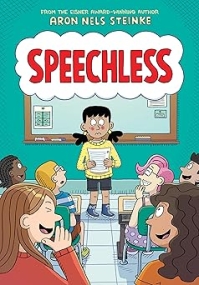
From Eisner Award-winning author Aron Nels Steinke comes a heartfelt and funny middle-grade graphic novel about friendship, anxiety, and expressing yourself.
Middle school was supposed to be a fresh start for Mira, who struggles to speak in class even though she can speak at home without a problem. Her former best friend, Chloe, has become her worst enemy, and Mira's only solace is making videos for her secret stop-motion animation channel. But when Chloe's mom has to travel for a family emergency, Mira is horrified to learn that her family has volunteered to let Chloe stay with them. When it feels like everything is going wrong, will Mira ever find her voice?

Editor reviews

2 reviews
Understanding Selective Mutism
(Updated: June 23, 2026)
Overall rating
 
4.0
Plot
 
4.0
Characters
 
4.0
Writing Style
 
4.0
Illustrations/Photos (if applicable)
 
4.0
Mia has problems with social anxiety that have led to years of increasing selective mutism, but she makes a goal for herself to talk in class as she enters middle school. Her first day is a bust, but other students, including former best friend and current nemesis, Chloe, tell the teachers that Mia just doesn't talk. This isn't evident at home, where Mia talks to her mother and father, as well as her younger sister Madeleine, who occasionally helps her with her computer animation projects. Under the name Danger Cat Studios, Mia uploads videos like Tommy Tomato and Bobby Banana. When she puts up posters at school advertising these, she gets a lot of views, and finds it amusing that no one knows she is responsible. She creates puppets to use in the videos, and makes one of Alex, a cool nonbinary kid on whom she has a bit of a crush. They stick up for Mia when classmates make fun of her, and even partners with her on a school project. Alex is surprised that Mia speaks at home, and the two have more fun with the animation projects than the school one. It doesn't go well, since Mia is dealing with the fact that Chloe is living with her family while her parents are taking care of her grandmother. Mia remembers that Chloe, in second grade, told her to quit pestering her, and has trouble when Chloe invites friends to the house. At one point, she suspects that Chloe has poisoned her spaghetti, and spirals to the point where her parents call the paramedics. Mia's grades aren't good, and when Mia's teacher finally calls her mother, the parents find out that Mia hasn't been talking at school. They get her in to therapy, and she slowly progresses from whispering to Alex, which isn't so hard, to speaking in front of groups.
Good Points
One of my second grade classmates was selectively mute, and this was very hard to understand as a child, so it's interesting to see this representation, especially since the author had a lesser degree of this condition when he was young. Mia and Chloe's friend drama makes sense (I personally still have grudges from elementary school!), but I was glad to see that Chloe wasn't really still mean to Mia, and her feelings were a little bit hurt as well. Alex sticking up for Mia and befriending her was also good to see. Mia's animation hobby was intriguing, and it wasn't unusual that her grades slipped in middle school. Steinke's illustrations (Mr. Wolf's Class) will appeal to middle school readers.

It was a little hard to believe that the parents didn't know that Mia wasn't speaking in class. When Mia didn't speak in middle school, the first thing that a teacher would do would be to check her file for diagnosis and accomodations, and when nothing was there, a phone call home would have been made!

This is a good choice for readers who like all of the graphic novels that deal with challenging middle school experiences. Raina Telgemeier set the bar with Smile, and these have continued with Hale's Real Friends, Durfy-Lavoie's Just Roll With It, Libenson's Invisible Emmy, Page's Button Pusher, Palmer's Campy Prodigy, Scrivan's Nat Enough, and many other titles.
Comments (0) | Was this review helpful? 0 0
Finding Your Voice in Unexpected Ways
(Updated: June 23, 2026)
Overall rating
 
4.3
Plot
 
5.0
Characters
 
4.0
Writing Style
 
4.0
Illustrations/Photos (if applicable)
 
4.0
Mira is about to start middle school and she is hoping this is a fresh start for her. She struggles to speak in class but can speak at home with no problems. Mira’s former best friend, Chloe, is her worst enemy and now it seems that her family has volunteered to let Chloe stay with them while her mom is traveling for a family emergency. The only escape that Mira has is her stop-motion animation channel. Will Mira ever be able to speak outside her home? Will she survive having Chloe live with her?

What I Liked: This book opens with an introduction to Mira and her going to the first day of school. Mira is excited and determined to speak in class this year but as the day goes on she can’t seem to speak up as attendance is called. Mira’s classmates all explain to the teachers that she just doesn’t speak. This portrayal of selective mutism or social anxiety is incredibly well done as it highlights the frustration of wanting to engage while feeling physically unable to do so. Readers who experience similar struggles will relate to Mira’s journey and find it validating, as this book acknowledges the complexities of verbal communication without treating it as something that needs to be “fixed.”

When Chloe comes to stay with Mira’s family, chaos ensues for Mira as she now has to live with her worst enemy. Chloe doesn’t seem to remember or understand why Mira is so angry at her and continues to try and be civil with her. The tension between these two adds an emotional depth to the story as you see how past hurts and unspoken feelings can build barriers between people. The book does a great job of showing how complex relationships can be and how communication plays a key role in that healing.

Mira spends all of her free time working on videos for her stop-motion animation channel which causes her grades to suffer. Due to this her parents take away her tablet and cell phone forcing Mira to hang out with her sister, friends, and Chloe. It is at this time that Mira learns to communicate with others in her own way and starts getting to know her sister and Chloe. The illustrations in this book play a critical role in telling the story as it visually distinguishes between Mira’s thoughts, whispered words, and spoken dialogue in a creative and clear manner. The art brings warmth and emotion to the narrative, making the characters’ interactions feel authentic.

Final Verdict: Speechless is a heartfelt and beautifully illustrated story highlighting the complexities of communication, social anxiety, and finding your own voice. It's refreshing to see how Mira learns to communicate in a way that feels comfortable for her, whether this is through whispering, gestures, or creative expression. This book is perfect for children and young adults who may struggle with verbal communication or know someone who does, this book is a great exploration of friendship, family, and self acceptance.
Comments (0) | Was this review helpful? 1 0

User reviews

There are no user reviews for this listing.
Already have an account? or Create an account