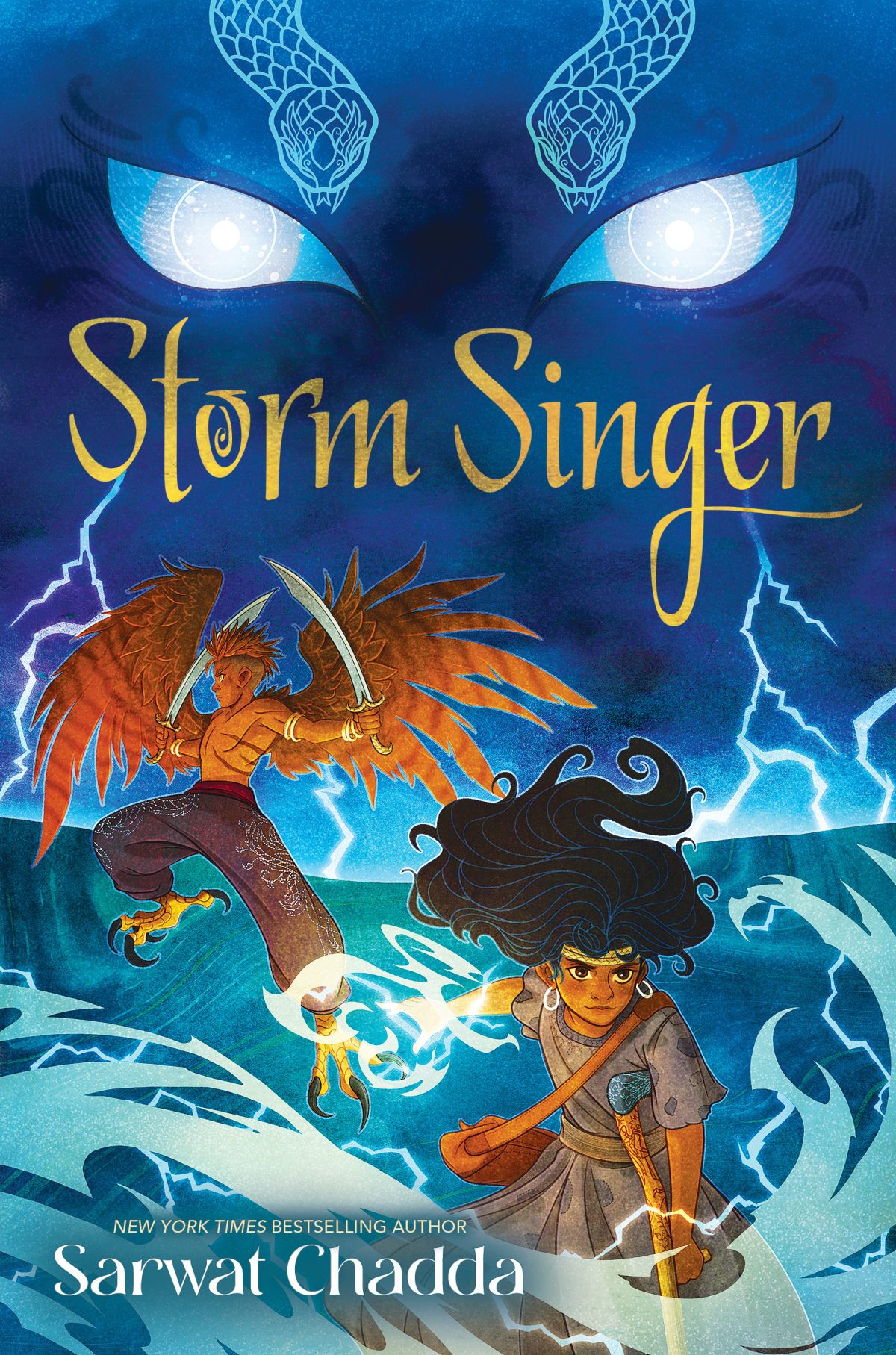
Today we’re spotlighting Storm Singer by Sarwat Chadda!
Read on for more about the author and the book!
About the Author: Sarwat Chadda

Sarwat Chadda is the New York Times bestselling author of the City of the Plague God duology, the Spiritstone Saga, the Ash Mistry trilogy, the Shadow Magic trilogy, and the Devil’s Kiss duology. He has written for Star Wars and Minecraft as well as the 39 Clues and Spirit Animals series. Sarwat is a first-generation Muslim immigrant of South Asian descent who loves writing over-the-top adventures. His work has received numerous starred reviews and was a Goodreads Choice Best Middle Grade Award Nominee. He has been published in over a dozen languages. Outside of novels, he’s written plays, comic books, and TV shows, including The Legend of Hanuman for Disney+ Hotstar. Sarwat lives in London. Feel free to drop him a line on X at @SarwatChadda and Instagram at @Sarwat_Chadda or visit him at SarwatChadda.com.
Website * Instagram * X * Facebook
About the Book: Storm Singer
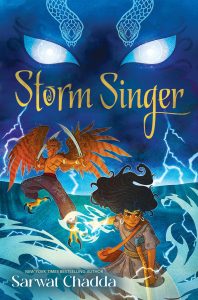
In a land ruled by fierce winged warriors known as eagle garudas, twelve-year-old Nargis is just a poor, lowly human, a Worm who hates the garudas that killed her parents. But even though she can’t fly—and her childhood attempt left her walking with a crutch—she is far from powerless. Nargis is a spirit singer: able to coax small bits of wind, water, fire, and earth to do her bidding through song…well, sometimes.
When Nargis loses control of her power in a high-stakes kite fight, she is exiled. Cast into the desert, she discovers Mistral, an injured boy who turns out to be an eagle garuda, the prince of her enemies! He’s on a mission to take back his throne from a terrible vulture garuda. In spite of their mutual distrust, the two have no choice but to forge an unlikely alliance if they want to escape the desert alive.
And as Nargis and Mistral battle dangerous assassins, befriend crafty sky pirates, and sneak into the mysterious sky castle of Alamut, Nargis discovers she carries a family secret, one that could bring Monsoon’s rains back to the desert, but only if she’s willing to risk her life in the bargain…
Amazon * B&N * IndieBound
~Author Chat~
YABC: What gave you the inspiration to write this book?
My dad. Born and spent his childhood in India, learnt all about the great Indian epics, the Ramayana and the Mahabharata, grew up reading the Arabian Nights. He took me to see the Sindbad movies as a kid, I missed a day off school when The Jungle Book was re-released! We talked about how it would be to combine those influences into one great big story, and that’s what STORM SINGER is, my wish to reclaim those golden moments when magic had no limits, the summers were forever and a day out with your dad was the best day ever.
YABC: What research did you do to write this book?
I’ve been adapting the Ramayana for TV for the last few years, with the Legend of Hanuman series, so was deeply immersed in that Indian epic. Re-read the Arabian Nights, and also had a cool trip out to Morocco to pick up the sights and sounds of an Islamic culture, and a night out in the Sahara! Then there’s plenty of random stuff, reading poems to get a flavour of the magic I would be using in STORM SINGER. That turned out to be the hardest part of the whole book!
YABC: What came first, the concept, landscape, characters, or something else?
Character, character, character! That’s the only thing the reader really takes away from a book. I can barely remember the plots of most of the books I’ve read (even written!), but it’s the heroes and villains that stick long after.
YABC: If you could only write one genre for the rest of your life, what would it be and why?
High fantasy. I LOVE IT. Why? It gives you the biggest canvas to write your stories. It allows you to explore themes that can encompass society, the way of the world, and provide opportunities to create heroes that couldn’t exist in any other genres, the real shapers of their worlds. And, basically, it’s just so much fun. I’ve had a blast writing about giant bats, kingdoms in the clouds, magicians and monsters galore!
YABC: What can readers expect to find in your books?
A few laughs, some heartbreak, a couple of flaws heroes you’d love to hang out with, and the call to rebel. To fight back against injustice, however it presents itself.
YABC: Which was the most difficult or emotional scene to narrate?
When Nargis learns the truth about her parents. It needed to land hard, but avoid overwriting the scene. You’ve got to trust your readers to bring their own experiences of loss and betrayal to make it work. You are not trying to describe the character’s emotions, you’re trying to awake those emotions in the reader.
YABC: What is your favorite snack when writing?
Decaff cappuccino. I used to love lemon muffins alongside but my waist could not take too many of those! I still miss them though.
YABC: If you could time travel what would you want to see?
Awesome question! I’d have liked to go back to when my parents were children, just to see what they were really like. I know my dad was incredibly badly misbehaved, but I’d like to know exactly how bad!
YABC: What other age group would you consider writing for?
Adult, and started that literally this week! I’ve recently returned to YA, and that book will be coming out Fall 2026. MG will always be the sweet spot, but it’s fun to explore.
YABC: What daily thing do you see that brings you joy?
I enjoy cooking quite a bit, the spicier the better! Since I work from home it’s more or less my main job. And while not daily I’ve started training in Muay Thai. I’ve a black belt in tae kwon do, but fancied training in something new. Way too old for it, but it’s great fun! Do that twice a week.
YABC: What do you do when you procrastinate?
Bizarrely, I write! I’m uttering addicted to old school table-top roleplaying games. I’m the gamesmaster, so every week I write up the next adventure, based on where the party ended the week before. It’s very fluid, never knowing how the story will unfurl. I’m also into painting gaming miniatures, I really, properly switch off from everything then, it’s all about getting that colour in exactly the right spot…
YABC: What’s a book you’ve recently read and loved?
The Land of Lost Things by John Connolly. It’s the long-awaited sequel to The Book of Lost Things which is in my top ten of all time. No fairy tale was ever darker.
YABC: What is your favorite writing space or routine?
Mornings I like to get out and write at my local cafe. Just a few hours so at least I’ve seen and spoken to a few people. Funnily enough I write best with background noise.
YABC: Is there an organization or cause that is close to your heart?
There are two. The development of a Children’s Cancer Ward at King’s College Hospital and UNRWA (United Nations Relief and Works Agency for Palestine).
YABC: What’s up next for you?
I’ve just wrapped up edits on THE CROW’S REVENGE, the sequel to STORM SINGER. It builds on the mythology of the first book, raises the stakes that Nargis and Mistral have to face, and brings back my favourite villain, Sickle. That comes out in Spring 2026, and I’ve another book in the fall, which is my first YA book since 2010!
~Excerpt~
LIGHTNING AT MIDNIGHT
Five years ago
Mommy puts her finger to her lips. “As quiet as a mouse, Nargis. Do you understand? As quiet as a mouse.”
I nod and hold out my small hand. “There’s room under the bed for both of us, Mommy.”
Mommy is kneeling, her long, straight black hair brushing the mud-packed floor as she helps me hide. She smiles, but her eyes are afraid. I want to cry.
She sees the tears welling and brushes my cheeks. Her fingers are thin but strong, and her skin is rough but warm. “Shh. Shh. Remember what I said?”
“As quiet as a mouse,” I whisper. I curl up under the bed, clutching my crutch against my chest. My fingertips find the grooves of Daddy’s carvings. I usually feel stron- ger when I have my crutch, but not now. I feel small and weak. Like a mouse.
There’s a creaking from the roof of our small hut, a scratching upon the dried-out palm fronds that Daddy
and Baba put up last spring. Is someone up there?
Then . . . the flapping. Those crisp fronds rustle, just like they do when the desert wind picks up. But there’s no wind tonight. Where’s the storm coming from?
Daddy’s outside. He’s talking to someone. I don’t know who. The only person who really comes to visit us is that greedy Pandit, and this doesn’t sound like him. Pandit grunts like a pig when he speaks. This voice is hard, like metal. I don’t like it. I nestle my crutch closer.
Mommy gives my hand one last squeeze. I don’t want to let go, ever. I start to pull. She can hide here too.
But Mommy slips her fingers free and stands.
I watch from under the bed as she brushes the dust from her threadbare sari, as if she wants to look her best, and then she looks around the hut. It’s just one room, really, but with a curtain at the far end for Baba when he’s here. The hut smells of sweet flowers and bitter herbs. Plant pots and jars crowd the shelves, and sprigs dangle from the rafters over our big block of a table. The shovel, pick, and Daddy’s other farming tools are all neatly lined up beside the door.
It’s as if she’s checking that everything is in place, or she just wants to remember it.
She hesitates, picks up a knife from the table, then opens the door and goes out to join Daddy.
Daddy is shouting. He tries never to get angry. Bad things happen when he’s angry.
The roof shakes. The candle flames begin to dance. I can see the tiny fire spirits, the ifreets, panicking.
The ground trembles, and cracks blossom on the plaster.
The wind suddenly howls and the door slams open, swinging angrily on its leather hinges.
I blink as the sand gets blown inside. I can see Daddy, yelling at someone I can’t see, while Mommy tries to pull Daddy toward our hut.
I want to yell, tell them to come hide here, with me.
But I have to be as quiet as a—
The door crashes shut so hard that plaster falls off the wall.
I hear a shriek. It’s as hard and as cruel as nails scratching slate.
Then Mommy screams.
I’ve never heard her make a sound like that. It’s the sound you might make when your world ends.
She stops. Just like that.
The silence is more horrible than her scream.
The wind drops to an empty, hollow moan. The candles flicker, and die.
Everything is still, except for my heart. The door creaks open, just a bit.
Mommy lies upon the ground. Daddy lies beside her.
I know they’ll never get back up.
I want to scream. I want to cry. But I have to be as quiet as a mouse.
Then, just before my heart breaks, I see a flash of white against the darkness.
I see lightning at midnight.
CHAPTER 1
My kite was something special. Swifter than a falcon, stronger than an eagle, and more beautiful than a kingfisher, it ruled the sky. It was more than a kite;
it was a sky-fighter. A patang.
The sun had only just come up, and the desert shim- mered with heat. I sat as comfortably as I could manage, in the shade of the rustling leaves of our great old ban- yan tree, beside my parents’ shrine of piled stones. Sat amongst my paint pots, brushes, and other materials, job finally done. I turned my patang slowly, savoring how the low sunlight shone through the multicolored tissue paper to cast a rainbow blanket over my lap.
The fiery red swirls gave it rage. It wouldn’t back down from its opponent, willing to take on anyone, anytime.
Next I’d painted blocks of gray for the earth, for power. A sky-fighter, a patang, must be strong.
I’d added blue meandering lines. Water was precious, but everyone knew that.
Finally, of course, wind. Soft brushstrokes of white
for the wind. It was life itself, breath, laughter, secret whispers.
All it needed was a name, but that wasn’t up to me. I’d give it to—
There was a clatter from the hut. A banging, then a cry.
I put my kite down against the tree trunk. “Baba?
What’s going on?”
“I can’t find my pants!” “Try on top of your head!”
“Oye!” he cried, exasperated. “I’ll have none of your cheek, young lady! I am your grandfather and deserve respect! I need to— Ah. Never mind!”
It wasn’t the first time Baba had woken up, grabbed the nearest strip of cloth, and wound it around his head, thinking it was his turban.
The hut door crashed open, and Baba hopped out, tying up his pants while his turban dangled loosely around his bald head. “Stop dawdling, Nargis! Help me! What are you doing . . . Oh.” He picked up my kite and cast his expert eye over it. He pushed it in from the sides, test- ing the flexibility of the bamboo frame, letting it spring back into shape, peering close for any tears in the tissue paper. “Marvelous, a real patang. Got a name for it?”
“You know I only build them, Baba.”
“Of course, of course.” Baba scratched his chin as he
gazed north. “The wind’s been blowing down from the Eyries all week. Perfect for kite season. Did you see the storm last night?”
“I saw a shooting star. Fell right out of the clouds.” “You make a wish?” he asked as he struggled with his
turban. “What’s wrong with this cloth?”
“Nothing. It’s your head that’s all out of shape.”
Baba grinned, exposing his few remaining teeth. “It’s my brain. Still expanding with all my deep thoughts! Any- way, did you? Make a wish?”
“Of course.”
“For what?” he asked. “The usual. Rain.”
Baba snorted. “Rain? Here? Carry on wishing, girl.”
I squinted to get a better look at him. He had his medicine bag dangling from his bony shoulder. “You off somewhere?”
“Lalpani,” he said, rewrapping his turban around his head. “Pandit’s peach tree’s sick.”
“Our peach tree. He stole it from us. From Dad.” “Nargis . . .”
“Look around you, Baba. Look where we live.”
“It’s easier for everyone if we live outside of Lalpani.
We’ve got all we need here, haven’t we?”
I gazed around our small farm sullenly. The mud- brick hut was so old, it sagged, and the palm fronds
covering the roof needed replacing. I was constantly sweeping sand from the herb garden. The low stone wall did nothing to prevent the wind from blowing sand in from the desert that surrounded us. Before dawn I’d filled the gullies that fed our small vegetable patch, lift- ing bucket after bucket from the well, but the morning sun had already dried them out. The tomatoes were tiny, and the yellow patch of mustard was weed infested. “We deserve much more.”
He sighed. “One day you’ll have everything, I prom- ise. No more patchwork shalwar kameezes. It’ll be saris of gold silk, and you’ll wear ruby earrings instead of those tin ones.”
“I like the noise these make.” I shook my head and let the earrings jangle.
Anyway, I didn’t want rubies. I wanted diamonds. Diamonds that fell from the sky.
Rain.
I closed my eyes and turned my face upward, imagin- ing the raindrops pummeling my skin, soaking me down to my bones.
Baba shook the dust off his sandals. “Why don’t you give your hair a quick brush? You always look as if . . . Hold on.” He narrowed his gaze suspiciously. “What’s that you’ve got wrapped round your head?”
“This? This is just for keeping my hair out of my eyes.”
“You must think I’ve got fungus for brains.” Baba grabbed the loose end and tugged it off. Hard.
“Ow, Baba!”
He waved the long twine object in front of my face. “A sling? How many times must we do this? I’m trying to make a respectable young lady out of you, Nargis!”
“Respectable, Baba? We’ll never be respectable!” I snatched the sling off him and wrapped it back in place, giving it an extra knot. “You wouldn’t recognize respect- able even if it grew out of your big hairy ears! Which reminds me, they need trimming! Shall I get the clippers?” “I like them hairy. And what do you need a sling for?
It’d better not be for the birds! You know the law about harming birds! The Patels got fined a sack of rice when their cat killed a sparrow! A sparrow!”
“I use it to scare the birds off our garden, that’s all. Otherwise they’d eat all the seeds. I promise I miss. Or you could stand out there all day. That might work.”
“Why would I . . . Oh. A scarecrow. I see. That’s what you think of your venerable grandfather, is it?” His lower lip trembled as he wiped away nonexistent tears. “Oye, what did I do to deserve such a grandchild?”
“I’m just following your example, Baba.”
“So it’s my fault?” He smoothed out his bushy eye- brows. “I thought I heard singing earlier.”
“‘Mom’s Song,’ while I was watering the plants.” I
gazed at the empty sky. Not a wisp of cloud. “One day it’ll work.”
He smiled at the memory. “Your mother had a voice sweeter than any nightingale! Can’t say the same about your father. Sounded as if he had a frog dying in his throat.”
“Then it’s good I inherited my voice from . . . Ribbit. Ribbit.” I coughed dramatically. “Sorry. It’s that frog again.”
Normally Baba would have laughed. Instead he chewed his mustache. He only did that when he was wor- ried. He’d been doing it a lot lately.
“I’ll come along,” I continued. “Someone wants this patang.” I rolled to my side and picked up my crutch.
What’s it for, Daddy?
For you to find your way, Nargis.
It had been six years since the accident. I could barely remember it, but my right leg reminded me every day, from when I woke till when I settled into bed. Dad had known I’d need the crutch forever and had designed it cleverly, with a sleeve over the main wooden shaft that could be extended as I grew, and the handle doubling as a peg to hold it in place. I adjusted the new padding I’d stitched around the armpit piece and blew the dust out of the carvings decorating the wood.
Dad had loved carving. My shelf was still cluttered
with wooden toys, my favorite a bird with flapping wings. The door, the frame around it, even the legs of the bed were decorated with swirls and mysterious patterns. I wrapped one finger at a time around the crutch handle and settled it under my left armpit. “Ready.”
“Good, good,” Baba replied vaguely, all the while chewing his mustache.
“It’ll be fine, Baba.”
He sighed. “It wasn’t fine last time.”
He’d been asked to heal one of the villagers’ fields, just a tiny patch of ground that was more stones than soil but had grown enough wheat to keep a family going. We still didn’t know what had gone wrong. The entire field had withered, right before our eyes, leaving Baba sick for a week, unable to eat or drink, his already scrawny frame turning skeletal. I’d tried every herb in the garden, but nothing had worked. I’d been terrified. I couldn’t let it happen again.
“I’ll do it,” I said.
“Huh?” Baba replied. “Do what?”
“Let me sing to Pandit’s peach tree. My song’s stron- ger than ever. The spirits are starting to listen.”
Baba screwed up his eyes until they’d almost disap- peared into his wrinkles. “Every time?”
“Yes. Mostly. More often than not.”
“Mostly is when it’s most dangerous, Nargis.”
I tried one last time to persuade him. “What’s the point of being able to command the elements if I never get the chance to do it? That dhal I cooked last night? I got the fire spirits working overtime! They were just wanting to sleep in the embers, but I gave them a few lines, and they were jumping everywhere.” I put my hand over my head. “This high!”
“‘Command,’ Nargis? We don’t command the elemen- tal spirits. That’s not what spirit singing is about. A song is to delight, to charm. To touch hearts. The spirits of the earth, of the air, fire, and water only offer their help if we ask nicely. Never, ever try to command a spirit.”
I picked up the patang, dangling it from the crook of my little finger. Making it suddenly didn’t feel that special anymore. “I suppose.”
He smiled kindly, but it didn’t soften my disappoint- ment. “Don’t be too much in a rush. Bad things happen when you rush. One day you’ll be as great as your father. Greater. A song will come, and it’ll change everything.” He gave the tips of his mustache a sharp twist. “Now let’s go be marvelous.”
The ground I wanted—needed—was flat, straight, and solid. The ground I had was anything but. My crutch constantly sank into the sand, each dip forcing another hiss from between my clenched teeth. It was only a mile between our
small farm and Lalpani, but it was a long mile, with the worst saved till last, the great sandbank wall littered with broken bricks and half-buried rubble that surrounded the village, which I cursed every step of the way up and swore at every step of the way down.
Lalpani wasn’t big. Some scattered fields and twenty or so mud-brick huts, with a well and a dried-out river nearby. Cattle sat in the shade, too listless to flick away the flies that swarmed around their rumps, and mangy dogs panted in the heat. Not much came through here except the wind. Hot and parched by the long journey down from the Eyries and across the desert, that wind was alive today.
Every kite was a shard of bright, bold color against the blistering sky, with some painted with images of birds, butterflies, and—of course—garudas.
The winged warriors ruled us, taking our food as taxes and giving nothing in return. I didn’t understand why we, the Earthbound, admired them. Maybe it made serving them easier.
Kites darted and danced over the entire village, their paper bodies rustling loudly. Kids crowded every roof, eyes on the sky, directing their kites with deft tugs of their twine, cheering when they won, shrieking when they lost.
Sky fighting was a serious business.
The adults were busy, as usual. Repairing their huts,
tending their animals, preparing meals on open fires, weav- ing carpets out of palm fronds. You worked, or you starved. I knew everyone, had helped most of them one way or another, but upon entering Lalpani, I didn’t even earn a smile.
Even after all this time, they were afraid. Moms pulled their children closer as we approached. A few touched their protective amulets and muttered prayers under their breath. I shuffled along, looking ahead and not at the scowls. “After all the times we’ve helped them, it doesn’t matter. I’m still just a witch.”
Baba shook his head. “A spirit singer. They just don’t understand.”
“We heal nature, Baba, and they still despise us. Why? They should be greeting us with garlands instead of this . . . hate. Doesn’t it bother you?”
Baba kicked a stone out of the way. “Since when did you care about the opinions of others?”
More often than I liked to admit.
“Ignore them,” said Baba, pointing ahead. “That’s why we’re here.”
The trees ahead looked like spindly old folk, frozen in a dance. As you got closer, they slowly revealed that their crooked limbs were branches laden with gem-like fruits, their leaves trembling in the hot breeze while sparrows, starlings, and blackbirds darted through the speckled shade. The true treasure of Lalpani.
Some villages, not many, might have a couple of date palms growing. Vaalipur had a papaya tree. Just the one, but it attracted merchants from a hundred miles away to trade.
Lalpani had an orchard.
Orange trees gently swayed as if dancing to a tune only they could hear. A gnarly mango stood with bowed branches weighed down by rich pickings. There were cherry trees and a few stout banana trees, while elegantly tall palm trees cast their leafy shade over goats nibbling at broken coconut husks. Gullies, almost as empty as ours, ran in neat rows and were fed by two shadoofs standing idle at either end.
We should have been rich, everyone here living in a palace from the wealth growing on those trees, but the orchard and every fruit was owned by one person. Pandit. He waited in the shade of a silk parasol, drinking lassi from a frosted glass. He’d had his hair done in a fine, bright green-and-blue crest, more than six inches tall—it would have looked even taller if it hadn’t been drooping. The dye streamed turquoise down his otherwise shaven scalp and into the folds of his fleshy neck. The thousands of feathers on his ankle-length cloak shimmered in the sunlight. The brilliant blue of the kingfisher, the vivid green of parakeets, the scarlet of toucans, countless more
that must have been imported from far, far away.
A peacock. Someone who mimicked the ways of the garudas. It was a joke, really. Birds that can’t fly. But maybe the joke was on us. Pandit owned the orchard, making him the richest man in the village. Peacocks might be useless, but they were proud.
“Namaste, Pandit Sahib,” said Baba, palms pressed together. “I’d touch your feet, but I’m not sure I’d be able to get up afterward. It’s these old bones, you see.”
I wiggled the toes of my crooked right foot. “I can’t kneel. So sorry.”
“Can’t, or won’t?” Pandit sneered. “Just get a move on.
My orchard is dying as you flap your mouth.”
“Your orchard?” I scowled at his ridiculous dye- stained face. “My dad planted every one of those seeds. His song created the orchard. Every single apricot, mango, orange, and peach over there is ours. You stole it from us.”
Pandit’s eyes darkened. “Payment for your debts. You know the law.”
“Talon Law, you mean.”
“What other law is there?” Pandit replied. “You spoil her. She needs to be reminded of who she is.”
“Oh, Nargis knows exactly who she is,” said Baba. Then he cleared his throat. “It’s good you called me. I can feel the peach tree’s pain from here. I’ll have her ripening in no time. Peaches fit for Alamut.”
“Just get on with it,” Pandit snapped.
Baba nudged me along, and we entered the orchard. There wasn’t much water trickling along the gullies feed- ing the trees, and it was scummy with yellow froth and smelled foul. I wrinkled my nose. “The water’s contami- nated. That’s why the peach tree’s sick.”
Baba frowned. “Soon it won’t just be the peach tree.
Everyone uses the well.”
Year by year the water level got lower and lower, and the water got more and more polluted. It didn’t rain here, hadn’t in centuries, and the underground rivers were finally drying up. How long before Lalpani became another abandoned village, slowly disappearing under the sands?
“Oye, Nargis!”
Arjuna darted through the trees and skidded to a halt in front of us, grinning. He stared at the kite. “Now, that’s the best one yet.”
I looked him up and down. “You look ridiculous.” “And namaste to you too.” He turned his head from
side to side, proudly displaying his own dyed crest, emer- ald green with yellow streaks. His cloak only came down to his waist, the feathers made up of wrinkled paper and limp cloth. Pandit didn’t allow his servants real feathers. “I think I look amazing. Enough about fashion, a subject you know nothing about,” said Arjuna, reaching for the patang. “Let’s have a closer look.”
I blocked him with my crutch. “Keep your sticky fin- gers off. Where are the mangoes you promised me?”
“Mangoes?” he replied vaguely, his attention focused on the patang.
“Six of your ripest. That was the deal.”
“Six?” he cried. “But I thought we were friends!”
I swung the patang back and forth. “You want me to make it ten?”
“Six, then. Give it here.”
I handed it over, and Arjuna whistled softly as he tested the frame. “I would have paid ten.”
Baba gestured over his shoulder. “Get going. The wind’s perfect today.”
I shook my head. “I’d better stay with you, Baba. Just in case.”
“I don’t need a nanny, Nargis. Now go.”
I was just trying to help, but you needed to be confi- dent when summoning the elemental spirits. Me standing over him was only going to undermine him. Baba gave his mustache tip an extra twist. “It’ll be fine.” Then he headed off to the peach tree.
“We’ll fly it up on the wall,” said Arjuna, practically skipping.
I groaned. He wanted me to march all the way back up? “That ridiculous wall? They should have knocked it down years ago.”
“That wall is to protect the village, Nargis.” “How? Our enemies come down from the sky.” Arjuna sighed. “Garudas aren’t our enemies.” “No, they’re our masters, which is worse.”
“Have you ever seen a garuda up close?” he asked. “I have. I’m not talking about the Raptor Lords caste, but once we had a kingfisher garuda visit on business. Gave Pandit one of his feathers as a gift. They’re not so differ- ent from us, not really. Apart from the wings, of course.”
“That’s a pretty big difference. And what about their claws? Their beaks?”
“Only a few have beaks. Most have faces just like ours,” Arjuna answered. We’d bickered about garudas for years, and it never got anywhere. “Another well’s run dry. Pandit had Hassan dig until he hit rock. Nothing.”
“Baba will find you some water. Oh, before I forget.” I pulled a small paper packet from my sash and handed it to him. “Give this to Bina. Tell her to mix it with her chai before bed. Only a pinch. It’s Baba’s dream root, and it’s a lot stronger than the sawdust the others sell. Too much, and she’ll sleep through the whole week.”
Arjuna nodded as he tucked it away, then turned his attention back to the orchard. “How long do you think it’ll take?”
“You can’t rush this. Bad things happen.” “Lalpani needs those peaches. I’ve got—”
“Arjuna! Where are those tools you promised me?” It was Hassan, the cow herder. “The shed’s not going to build itself.”
“Where’s that bucket of milk you promised me?” said Arjuna. “Tomorrow, Hassan!”
“Tools?” I asked. “Where did you get those from, or shouldn’t I ask?”
He winked. I shouldn’t ask.
The baker gave him a naan fresh from the oven. After hesitating for a moment, the baker handed me one. Lakshmi waved Arjuna to her door and slipped him a let- ter she wanted delivered, and a rupee to make sure no one knew to whom.
Arjuna was handsome, charming, and friendly, every- thing I wasn’t. Why we were friends was a mystery to the whole of Lalpani. We were the same age, give or take a few months, and had known each other for years, pretty much since soon after he’d started serving Pandit, after Arjuna’s parents had sold him into service. Ten years for a few sacks of grain. That’s why Pandit was so rich. Desper- ate people make desperate bargains, so Pandit made sure he paid as little as possible for as much as possible.
But Arjuna hadn’t let that stop him. Poor peasant ser- vant that he was, everyone loved him.
Almost everyone.
Krish waited for us in the middle of the street, along
with brutish Angad. He twirled his kite on his finger. “Why aren’t you working, Arjuna? The latrines need cleaning.”
Krish was Pandit’s one and only son, and everyone knew that one day he’d be in charge of everything. It didn’t matter if Arjuna did all the work. Krish collected all the profit.
All that joy, all that confidence, just evaporated. Arjuna lowered his gaze. “Your father gave me the day off. It’s the beginning of the rainy season. Everyone flies kites this week.”
Krish searched the sky. “Rainy season? Where are the clouds, then?”
I stepped up between them. “The wind’s blowing from the mountains. That’s when the rains used to come.”
Krish smirked. “Ah, Monsoon. She’s just a fairy tale.” “She was real,” I said. “But the garudas killed her.”
Krish laughed as he turned to Angad. “That’s Nargis for you. Everything’s the garudas’ fault. She stubs her toe, blames a garuda. Can’t find her crutch, a garuda swooped down in the middle of the night and stole it.” Then he turned his attention back to Arjuna, and the kite. “That kite’s way too nice for a peasant like you. Give it to me. Now.”
I’d spent days making that kite, for Arjuna. Krish was not going to have it. I stuck my crutch out at Krish’s chest. “It’s mine.”
Krish paused, and frowned. “Everyone knows you don’t fly.”
“Everyone’s wrong,” I said. I gazed at his bat-winged patang and snorted. “Now get lost before I tear that rag of yours to shreds.”
“You really think you can take on Rakshasa? The Demon?” Krish snarled.
“Of course.”
The snarl became a smirk. “You’re on, witch.”
I raised my crutch. Krish flinched. Then he narrowed his gaze. “Go on, I dare you. Hit me and see what hap- pens.”
My arm was trembling with the urge to do exactly that, but nothing good would come out of it. He wasn’t the only one who called me a witch, but he was the only one who’d say it to my face.
I lowered my crutch, screwing the tip solidly into the ground.
They strode off. Then Arjuna turned to me and sighed. “That was close.”
“There’s a better way of teaching Krish some respect,” I said. “By ripping his patang out of the sky.”
“And how are you going to do that?”
“How do you think?” Kites crowded the sky, everyone playing and fighting. It was a good wind. “I’m going to cheat.”
Title: Storm Singer
Author: Sarwat Chadda
Release Date: 4/15/25
Publisher: S&S Books for Young Readers
Genre: Middle Grade Fiction
Age Range: 8-12