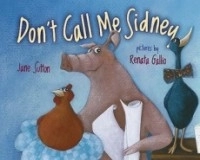
Sidney, a rather rotund pig, loves to write rhyming poems for his friends? birthdays. On one such occasion, he realizes his own name doesn?t rhyme with anything except . . . well, kidney. This just will not do. Sidney resolves to change his name to Joe, an extremely rhyme-able name. But being ?Joe? is hard to remember. His friends aren?t that keen on it. And when Sidney?s mom finds out, she?s crushed. After all, Sidney was named after his greatgreat- great-grandfather, the inventor of the mop! What?s a pig with a non-rhyming name to do? Jane Sutton?s text is full of laughs, and wonderfully complemented by Renata Gallio?s charming characters, quirky details, and rolling perspectives. Kids will love Sidney?s solution and identify with his name-changing plight.
- Books
- Kids Fiction & Indies
- Kids Fiction
- Don't Call Me Sidney
Don't Call Me Sidney
Author(s)
Publisher
Genre(s)
Age Range
4+
Release Date
June 10, 2010
ISBN
0803727534
Buy This Book


Sidney, a rather rotund pig, loves to write rhyming poems for his friends? birthdays. On one such occasion, he realizes his own name doesn?t rhyme with anything except . . . well, kidney. This just will not do. Sidney resolves to change his name to Joe, an extremely rhyme-able name. But being ?Joe? is hard to remember. His friends aren?t that keen on it. And when Sidney?s mom finds out, she?s crushed. After all, Sidney was named after his greatgreat- great-grandfather, the inventor of the mop! What?s a pig with a non-rhyming name to do? Jane Sutton?s text is full of laughs, and wonderfully complemented by Renata Gallio?s charming characters, quirky details, and rolling perspectives. Kids will love Sidney?s solution and identify with his name-changing plight.

Editor reviews
2 reviews
A Poetic Pig with a Problematic Name
(Updated: July 26, 2026)
Overall rating
3.0
Plot
3.0
Characters
N/A
Writing Style
N/A
Illustrations/Photos (if applicable)
N/A
Sidney loves to write poems, but when he creates one for a friend, he realizes his own name wont rhyme with anything but kidney. Sidney searches for a new rhyme-able name and settles on Joe, but when his friends and his mother tell him they prefer his original name (he was after all, named after his great-great-great grandfather who invented the mop!) he rethinks his moniker and settles on a better option.
Dont Call Me Sidney by Jane Sutton addresses a relevant subject for children learning to appreciate ones name.
Sidney is a gentle, high-minded character who deeply cares for others feelings and thus admirably anchors the story. But his poetry could be construed as either A) highly realistic for what children write or B) exceptionally mediocre verse that could have been better executed for the sake of the story. The answer is probably A, but had Sidney been a truly good poet, the story would have benefited. The humor of Sidneys situation, a lousy poet concerned over a non-rhyming name, will be lost on young children and perhaps even adults. Besides, lets teach children about excellent verse by example.
This said, the book subtly encourages children to chase their passions and to persevere when complications arise (e.g., Sidney continues to pursue his love of poetry even when a difficult name throws him for a loop.) Sidneys respect for his mother and love of his friends also set a positive example for children.
Illustrator Renata Gallio uses acrylics, pencil and collage to reveal a plush look in muted tones. The texture of the canvas shows in the book and creates this feel.
Dont Call Me Sidney by Jane Sutton addresses a relevant subject for children learning to appreciate ones name.
Sidney is a gentle, high-minded character who deeply cares for others feelings and thus admirably anchors the story. But his poetry could be construed as either A) highly realistic for what children write or B) exceptionally mediocre verse that could have been better executed for the sake of the story. The answer is probably A, but had Sidney been a truly good poet, the story would have benefited. The humor of Sidneys situation, a lousy poet concerned over a non-rhyming name, will be lost on young children and perhaps even adults. Besides, lets teach children about excellent verse by example.
This said, the book subtly encourages children to chase their passions and to persevere when complications arise (e.g., Sidney continues to pursue his love of poetry even when a difficult name throws him for a loop.) Sidneys respect for his mother and love of his friends also set a positive example for children.
Illustrator Renata Gallio uses acrylics, pencil and collage to reveal a plush look in muted tones. The texture of the canvas shows in the book and creates this feel.
G
Guest
User reviews
1 review
Overall rating
5.0
Plot
5.0(1)
Characters
N/A(0)
Writing Style
N/A(0)
Illustrations/Photos (if applicable)
N/A(0)
Already have an account? Log in now or Create an account
A Poet with a Problem
(Updated: July 26, 2026)
Overall rating
5.0
Plot
5.0
Characters
N/A
Writing Style
N/A
Illustrations/Photos (if applicable)
N/A
Reader reviewed by Margaret Bruell
Sidney the pig enjoys writing poems for his friends. However, he becomes frustrated when he tries to write one about himself. Nothing rhymes with Sydney. When he changes his name to Joe, his mom and friends can't get used to it, and neither can Sydney. In fact, he has to write Joe on his arm in red ink to remember his new name. After a sleepless night, Sydney comes up with a solution that pleases everyone.
Sidney the pig enjoys writing poems for his friends. However, he becomes frustrated when he tries to write one about himself. Nothing rhymes with Sydney. When he changes his name to Joe, his mom and friends can't get used to it, and neither can Sydney. In fact, he has to write Joe on his arm in red ink to remember his new name. After a sleepless night, Sydney comes up with a solution that pleases everyone.
This is a gentle book with beautiful illustrations. Children will enjoy the humor and plot twists. Though it's a simple story, there's ample food for thought about names and identity.
There are also opportunities for predictions. How will Sydney solve his dilemma?
Parents and teachers who read the book aloud to children will appreciate the message that poetry can be an enjoyable part of everyday life.
G
Guest
Latest Additions





GET A YABC BUTTON!


We have all sorts of YABC buttons for your website. Grab one here and link to YABC!