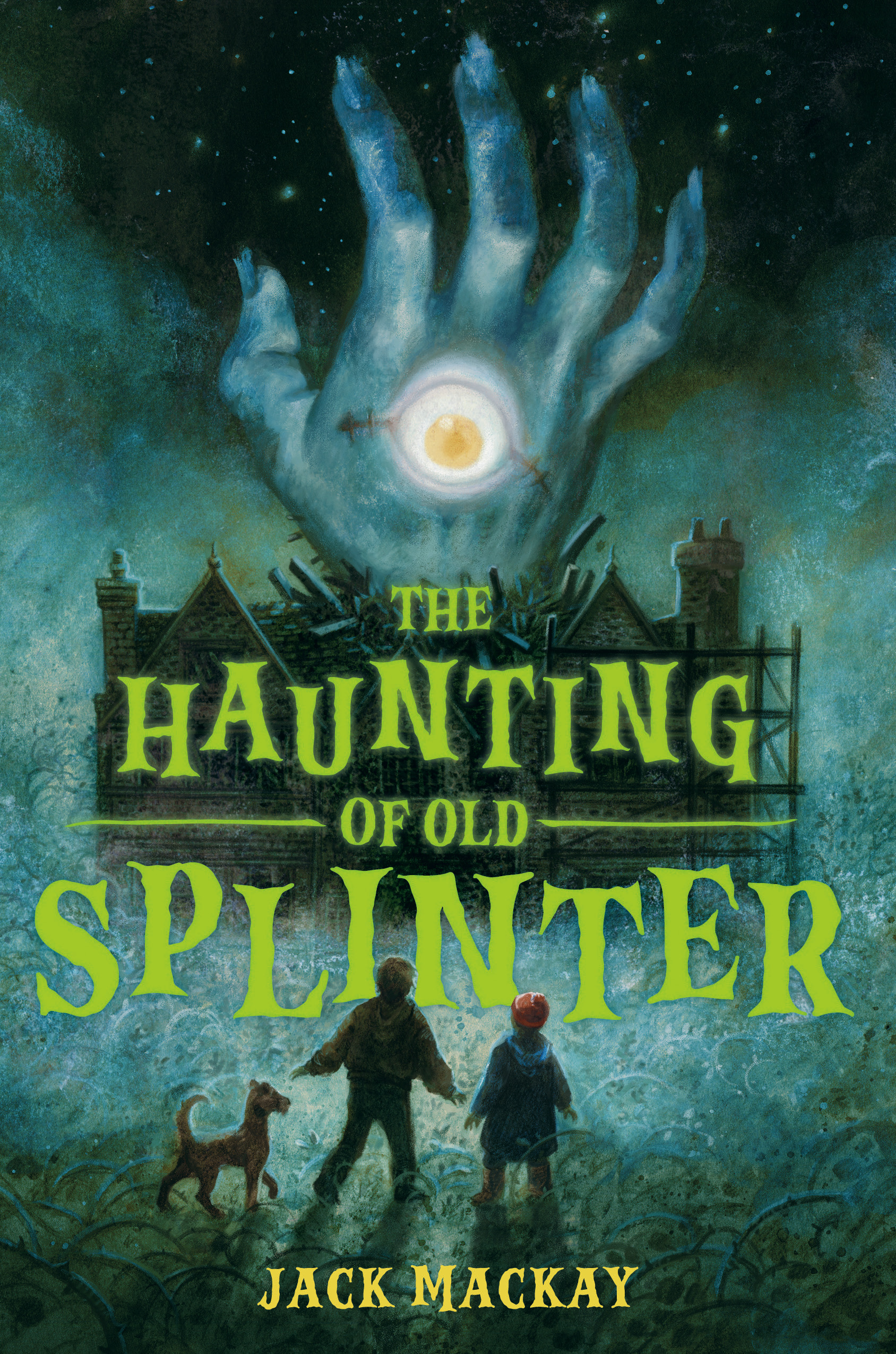
Today we are very excited to share an interview with Author Jack Mackay (The Haunting of Old Splinter)!
Meet the Author: Jack Mackay
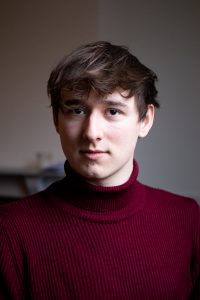
Jack Mackay is a writer, theater-maker and horror enthusiast. Though he’s currently floating around somewhere near York, his heart is in the Midlands, in his grandparents’ creaky old house. He has written stories since he was four years old. He is also the co-founder of Griffonage Theatre, a York-based company with a taste for the madcap and macabre. He loves his family, his dog, The Texas Chain Saw Massacre and K-pop.
About the Book: The Haunting of Old Splinter
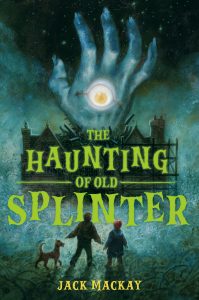
Innocent wishes turn decidedly sinister in this chilling horror for fans of Katherine Arden and R. L. Stine.
Peter and his half brother, Adrian, live in the shadow of Old Splinter—a formerly lavish estate now in ruins. Rumored to have once housed an eccentric magician, it’s now home to little more than spiderwebs and mold. Tasked with renovating the crumbling mansion on behalf of their wealthy uncle, Peter’s stepdad is at his wits’ end. And the cracks are beginning to show in their once-happy cottage.
A mysterious local legend may be their only hope. The wishing claw, a magical hand that grants your deepest desires, has spell-bound townsfolk for centuries. If it’s real—if he can find it—then Peter might just save his family! But wishes are tricky things and they always come with a price. What starts innocently enough soon unearths much more than Peter bargained for, including a dark secret lurking in the walls of the mansion…and a monstrous hunger that comes knocking at his door.
~Author Chat~
YABC: What inspired you to write this book?
When I was about thirteen, we read a short story in my English class called “The Monkey’s Paw” by W.W. Jacobs. It’s a story about an older couple who come into possession of a pickled monkey’s paw which has the power to grant wishes, and it all goes wrong in the creepiest way. Now I know the story is something of a horror classic, but back then it was brand new to me; I still remember how chilled I felt when I read it for the first time. There’s a particular scene involving a faceless thing knocking on the door which has stuck with me ever since. Fast forward nearly a decade, and my agent and I were discussing scary stories we read when we were young. She mentioned “The Monkey’s Paw” and I felt inspired to seek it out again. Even as an adult, the story is absolutely spine-tingling. I realized that it would be a great springboard for my next book, so I took the central idea (a possibly malevolent pickled hand that grants wishes) and tried to twist it into a setting which would be more familiar to a young audience today. The more I wrote, the more the story morphed into something of my own.
YABC: What research did you do to write this book?
I have to guiltily admit that part of the reason I write horror and fantasy is because the research is minimal. It’s generally safe to pull almost everything from your own life and your imagination. It’s not that I don’t enjoy research; I just find it easy to get bogged down in detail and end up struggling to see the wood for the trees, so I try and keep research light. Occasionally, however, your imagination takes you to places and topics that you can’t write about properly unless you look into them. My search history while writing this book featured tangents on the urban layout of Macau, the step-by-step process of renovating old mansions, and a disturbing amount of taxidermy. I also made sure to run things by my dad whenever I was anxious about accurately representing Hong Kong sayings or culture (and the proper Anglicized spelling of mahjong, which is apparently contentious!)
YABC: What came first, the concept, landscape, characters, or something else?
“The Monkey’s Paw” was the initial foundation, and I’d also read a lot of Edgar Allan Poe recently, so elements from his writing started to creep in too. But the thing that really unlocked the story for me was discovering the family dynamic at its core. Something the original Jacobs story does so well is that all of its horror – the real, bone-deep stuff – stems from the way the author leverages the parent-son relationship, so I decided to build OLD SPLINTER around the same thing. As someone from a blended family, I also felt like I had an opportunity to reflect a family structure which isn’t usually given as much thought in middle grade fiction – and if it is, the stepfather/mother is usually neglectful or villainous. My upbringing was always quite healthy and lovely, but I asked myself: what if a kid in my situation had been a little less lucky? What if he had to carry all the angst I was always shielded from? Once I understood Peter, his place in the world and his complicated relationship with his stepdad George (and step-uncle Lawrence), the rest of the story opened up to me.
YABC: If you could only write one genre for the rest of your life, what would it be and why?
Horror is home. I think I could write horror stories forever and not get bored or run out of material. You can ask any question at all in this genre, and many of those questions will get their most interesting, layered and horrifying answers when filtered through the prism of the horror story.
YABC: What can readers expect to find in your books?
I want to write books that take their young audience seriously, and as a result you can safely expect to find a couple of things when you open a Jack Mackay book.
First, something dark or scary. I’m a big believer in the idea that horror is for everyone, and that kids can handle much more than most adults think they can. Some books might slap a vampire or a werewolf on the cover and therefore claim to be a horror story, but in my opinion it’s not horror unless it’s actually frightening. I’m naturally drawn to darkness, to complexity, to the taboo. Children are, too; at least, I was when I was eleven. So you can always expect to find something creepy, shocking or gruesome in a Mackay book, because I know that’s what a lot of people are looking for, myself included.
Second, as an addendum to the first, I love monsters. I love designing them, I love writing about them, I love giving them extra limbs and teeth and horrible lairs. I love thinking about why monsters look the way they look – what does it tell us about the human fears they might represent? I agree with Guillermo Del Toro, who says that monsters are living metaphors. Every scary thing I write about will usually have a purpose. Monsters scare us for a reason – my books like to ask: what is that reason?
Third, a focus on family. My family is very important to me, so naturally it’s quite important to my characters, too. I like exploring the different ways that families behave and all the strange and subtle dynamics between them.
YABC: Which was the most difficult or emotional scene to narrate?
In this book, Peter has fraught relationships with both his stepdad and his biological father. The scenes that revolve around these relationships make up the soul of the story, so I felt a pressure to get them right. They weren’t exactly difficult to write at first – I find that sometimes the more vital a scene is, the more it just comes flowing out, because it’s closer to the surface. It’s the core of the novel, the whole reason you wrote it, and therefore the thing you’ve been thinking about the most in your spare time. But when it comes to refining those scenes to really draw out the less obvious details and the depth of feeling beneath them, the whole experience becomes much more challenging. Rather than just letting the writing pour out free-flow, you have to be more strategic in evaluating both your characters’ emotional legibility and your own. Even though I’ve never personally felt anywhere near the kind of friction that Peter feels when it comes to his family, it’s as much an investigative process as it is an imaginative one; you have to get pretty real.
YABC: What is your favorite snack when writing?
I usually write in cafés, so if I can get my hands on a latte and a cinnamon bun, I’m golden. I’ll usually head to the sushi restaurant nearby for lunch, so I’ve come to associate the taste of raw salmon with a productive day of writing.
YABC: What do you do when you procrastinate?
I’m a chronic procrastinator, usually because I’m distracted by something like my phone or my Xbox, or sometimes just getting stuck in a Wikipedia rabbit hole. Procrastination is a symptom that I have something else on my mind, or I haven’t given my brain the space to think, to imagine, and therefore I’m not in the mood to write. I think we’ve all become acclimatized to constant stimulation, to the feeling of always having something to look at or listen to; that’s what leads us to avoid activities which require a singular, sustained focus. I’m trying to get better at putting my phone in another room and detoxing from technology for a little while before sitting down to write – that even includes music! Going for a walk in the local park helps clear my mind. All it takes is ten minutes of totally free, undistracted thought and I’m usually ready to write again.
YABC: What’s a book you’ve recently read and loved?
I just finished The Other Wind, the last book in Ursula K. Le Guin’s Earthsea series, which I am finishing for the first time. I have lived in Earthsea – or at least I’ve been visiting it regularly – for less than a year, but I still came to this book with a certain heaviness because I didn’t want to leave this world behind yet. Earthsea is a clear example of a series deepening rather than broadening, and the experience of reading it was like a door being opened in my mind, through which I can see not only a vista of a new and stimulating fantasy world, but also an uncomfortable truth about the way we perceive the minds of young people in the 21st century. My suspicion is that if you wrote The Wizard of Earthsea in 2026 and pitched it as a teen novel, you’d be laughed out of the room. Surely something so lyrical, so purposefully paced, so philosophically dense, could only be intended for adults? I think that says something about the posture that many adults hold towards children and teenagers today – that they are adults-in-waiting to be distracted and entertained, not curious individual personalities to be engaged and challenged. If I ever need reminding of my responsibility as a children’s author to write up, not down, for my young readership, I will reopen an Earthsea book.
YABC: What is your favorite writing space or routine?
I like to write in cafes. Separating my home from my workspace helps me settle into a writer’s mindset, and the walk from my flat to the local Waterstones, through the bustle of a (currently sunny) public garden, usually puts me in a good place. The idea that the best art comes from suffering is a nonsense; creating is easier when you’re happy. However, I think we as writers tend to overthink the process of writing and lean on familiar rituals as a sort of cheat code, but the truth is, no matter what mood we’re in when we write it, the first draft always comes out rough. I actually find it much more desirable to take down the hurdles we make ourselves jump, remove the ritualized behaviors which make the idea of writing into something scary and arduous, and instead let the words come freely, even if it’s a couple notes before bed, or a doodle over lunch, or a scrawled line in a notebook while waiting in a queue. The film director Bong Joon-ho when he said that he tries to write “naturally, like breathing.” I haven’t got there myself yet, but it’s a nice idea.
Title: The Haunting of Old Splinter
Author: Jack Mackay
Release Date: 7/21/2026
Publisher: Viking Books for Young Readers
Genre: Middle Grade – Fiction
Age Range: 8-12