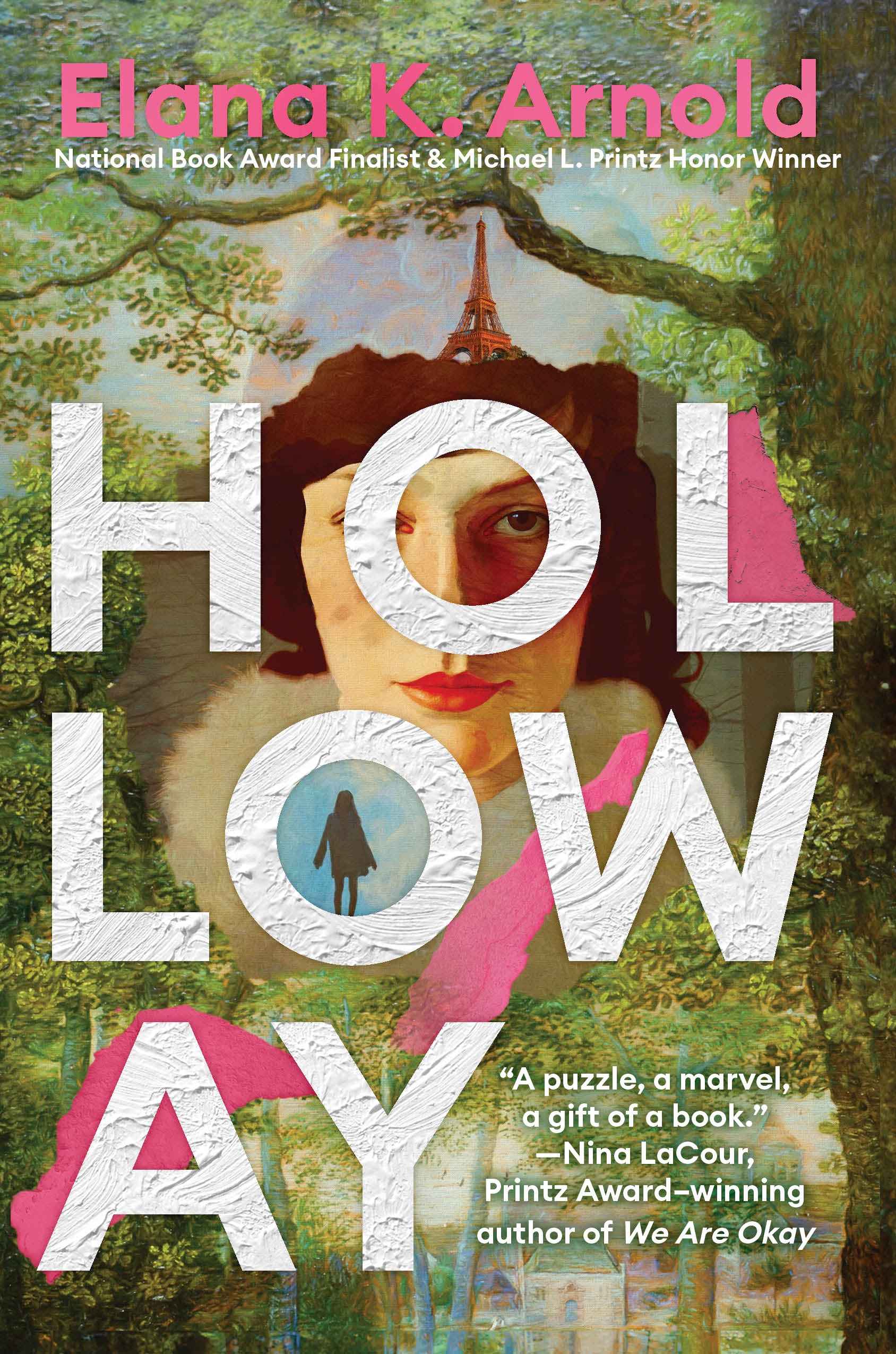
Today we’re spotlighting Holloway by Elana K. Arnold!
Read on for more about the author and the book!
About the Author: Elana K. Arnold

Elana K. Arnold is the award-winning author of many books for children and teens, including the Sydney Taylor and National Jewish Book Award winner The Blood Years, the Printz Honor winner Damsel, the National Book Award finalist What Girls Are Made Of, and the Global Read Aloud selection A Boy Called Bat. She lives in Long Beach, California, with her husband, two children, and a menagerie of animals. You can find her online at elanakarnold.com.
Website * Facebook * Instagram * X
About the Book: Holloway
Award-winning author Elana K. Arnold returns with a boldly visionary, deeply felt story that crosses space and time to examine loss and love in a world on the brink.
It is the late summer of 2021, and a girl named Nora is on the Paris Metro.
Nora, whose mother loved her, even though Nora was broken.
Nora, who couldn’t help her mother when her mother needed her most.
Nora, from whom the pandemic has taken nearly everything, save the object she clings to: a cylinder containing her mother’s ashes.
With no family left, no friends to speak of, and no way to turn back time, Nora has come to France to keep a promise she never got to make: to spread the ashes in a place her mother never got to see. But instead, Nora finds herself on the run through a forest in the night, taking refuge in a dark holloway. And when she wakes, and tries to make her way back to something she recognizes, she realizes that is impossible.
Because it is no longer 2021.
Questioning everything—including her own sanity—Nora sets out on a journey through a time and place completely foreign to her, and yet one that, much like the time and place she came from, is defined by death, loss, fear, and uncertainty. A journey in which she must find a way to honor her mother—and heal herself—in a world that feels irrevocably broken.
~Excerpt~
It’s the last day of August, 2021, and I’m on the Métro, bleary-eyed and jetlagged, cutting beneath Paris. My brain understands that I’m in a different time zone, but my body doesn’t, not yet. Yesterday, back home in California—where I used to live—I boarded a plane at six in the evening; when we landed, the flight attendant informed us that it was two in the afternoon. The magnitude of the disorientation that results from moving one’s body at an unnatural speed across space and time cannot be overstated.
My brain knows that I can’t fall asleep because that would mean I’ll miss my stop, but my body insists that I close my eyes. I lean my head against the wall of the Métro train. It’s hard and cold and most likely not particularly clean, but what a relief to rest. When I close my eyes, there’s Gillian, smiling at me. The warm weight of her hand upon my head.
Then comes a bark of a cough, and quick as a reflex, I press the metal piece of my mask across the bridge of my nose. The cougher is a police officer, white, in his sixties, I’d guess, wearing all the regular parts of a police officer’s uniform—the jacket, the pants, the boots, and the cap, the “bonnet de police,” a funny name, for Americans, for whom bonnets are associated with characters like Little Bo-Peep, charming little feckless girls—plus a mask, black to match the cap. Is the mask part of the uniform now, or is he required to provide his own?
This is the sort of thing that interests me—or that used to interest me, I should say. Before the virus and the shutdown, I might have asked him about it. Of course, back when I would have been interested, when I might have asked . . . back then, no one was wearing masks.
He’s seen me staring, which I hadn’t meant to do, but which happens when I get lost in detail. He raises a gloved hand—in greeting, to apologize for coughing, I don’t know which. Latex gloves, black.
The virus can’t be transmitted through nonporous objects, the way the flu can. That’s one of the things we’ve learned. Just over a year and a half ago, when the virus was new, before we knew all the things we know now, television doctors demonstrated how to spray down groceries, how to use antibacterial wipes on hard surfaces, how to properly wash our hands, singing the ABC song as they lathered and scrubbed. Gillian and I sat side by side on the couch, clutching each other’s hands as we watched the television doctor demonstrate handwashing best practices as if we were a whole country of preschoolers. It was ridiculous, but I was comforted. The doctor was describing the rules of the virus, just as the lines on the blacktop described the rules of the games. If we followed the rules, we would be safe. If we broke them, not safe.
I want to tell the officer that he doesn’t need the gloves. That the important thing is the mask, and the vaccine. But words are hard for me again, for many reasons. It’s not that I don’t speak French—I do, and fairly well. Language has long been a special interest—along with art, philosophy, and animals of all kinds. I also speak passable Italian and German, some Hebrew, and English, of course. Big Nora spoke French to me when I was young, and occasionally Gillian would try, though my knowledge of the language surpassed hers years ago. It’s funny—funny-strange, not funny-haha—that language is something that interests me so deeply, considering the times when language seems not at all interested in me.
Anyway, no one over here particularly wants to hear an American voice speaking any language, especially one telling others what to do, or what they should or shouldn’t be concerned about. We’ve lost quite a bit of credibility over the past few years.
The officer’s attention drifts as he scans the Métro car. For something to do as well as out of habit, I find the hand sanitizer in the pocket of my windbreaker. It’s cold and I hate the smell of it, the slime of it too as I rub it between my fingers.
Over the intercom, a man’s voice announces the stop as we pull into a station. The doors clang open, then closed. Another train on the tracks across from us, a high whine as it pulls away in the opposite direction. We roll forward, too—it’s funny, that their forward is that way, and our forward is this, and for a second it feels like we’re going backward, not forward at all. I hold up my hands and watch them vibrate. I try to force them to go still but I can’t make them stop. Control is an illusion, it turns out.
I place my hands on my thighs and try to focus on things that calm me—like the sound of the train’s metal wheels, rolling along the iron rails. It’s satisfying, the texture of the sound. Again, I close my eyes and lean my cheek against the window. The glass is cool and hard, I tell myself first in English, then in French, for practice.
The tracks are hard and made of iron. Les rails sont durs et en acier. I am safe, I am safe. Je suis en sécurité, je suis en sécurité.
It calms me to tell myself these things. Some of them are facts, and others are not. But it soothes me to say them, the way I used to be soothed by others.
There is no one left to soothe me anymore.
Title: Holloway
Author: Elana K. Arnold
Release Date: 5/5/26
Publisher: Clarion Books
Genre: YA
Age Range: 14+