About This Book:
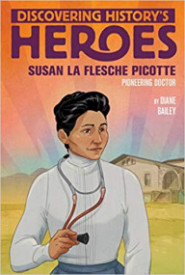
Jeter Publishing presents a series that celebrates men and women who altered the course of history but may not be as well-known as their counterparts. In this middle grade biography, learn about Susan LaFlesche Picotte, the first Native American woman to earn a medical degree.
Susan LaFlesche Picotte was the first Native American doctor in the United States and served more than 1,300 patients over 450 square miles in the late 1800s.
Susan was the daughter of mixed-race (white and Native American) parents, and struggled much of her life with trying to balance the two worlds. As a child, she watched an elderly Omaha Indian woman die on the reservation because no white doctor would come help. When she grew older, Susan attended one of just a handful of medical schools that accepted women, graduating top of her class as the country’s first Native American physician.
Returning to her native Nebraska, Susan dedicated her life to working with Native American populations, battling epidemics from smallpox to tuberculosis that ravaged reservations during the final decades of the 19th century.
Blizzards and frigid temperatures were just part of the job for Susan, who took her horse and buggy for house calls no matter what the weather conditions. Before her death in 1915, she also established public health initiatives and even built a hospital.
*Review Contributed by Karen Yingling, Staff Reviewer*
Pioneering Woman in Medicine
Born in 1865 in the Great Plains, Susan La Flesche was raised in the Omaha tribe. Her father was a leader, and while proud of his Native American heritgae, believed that his people would be more successful if they learned to adapt to white ways, which didn’t always endear him to his people. Susan was sent to a Presbyterian Mission school from the age of three, and continued with her education. She and her sisters were encouraged to speak English. She was eventually sent to school in New Jersey, and after helping an ethnologist who became ill while staying with the Omaha, she ws sent to the Hampton Normal and Agricultural School in Cheseapeake, Virginia. This was originally meant for African Americans, but started to include other peoples as well. Encourage by the doctor at that school, a woman, she applied to the Women’s Medical College of Pennsylvania and was able to attend after getting scholarships. It was not easy, but she graduated in 1889 as the first Native American to get a medical degree. She took jobs back home, but the very long hours, due to lack of other practicing doctors, negatively impacted her health. She tried to cut back, but was driven to help people in need. She eventually married and had two sons, but went in and out of medicine, always focusing on getting help to people in need. Her continued ill health led to her early death in 1915.
La Flesche Picotte’s story is a difficult one, because while she helped out the Native American community, she went through traditional white channels to become educated. Her father was a controversial figure, but this should not stop us from learning about her acchievements. Few women were able to get medical degrees in the late 1800s, and the fact that she managed to do this is rather remarkable. While it would have been good to see a Native American author write this, it is very delicately done and due diligence was certainly taken to show the difficulties and prejudices faced by Native Americans during this time period.
Discovering History’s Heroes has a good range of biographies of somewhat lesser known historical figures, including Michael Collins, Dennis Brutus, and Ida B. Wells, and is a great addition to biographies like the Who Was series and the various books NatGeo Kids .