
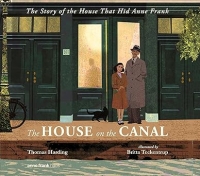
In the middle of Amsterdam is a house on a canal with a green door. Over four hundred years, it has quietly witnessed love, desperation, and historic change. Sometimes the narrow house was splendidly decorated, humming with life and love; other times, it stood empty, in near ruins. Sometimes the green door was open and inviting; other times, it was closed against cold and plague or to conceal the victims of wartime persecution. The house’s last occupant, a young girl with a sweet smile, would famously document her time there. In her diary, Anne Frank wrote of “the old house on the canal,” and today people come from far and wide to visit what stands as a universal symbol of hope and resilience. Thomas Harding’s lyrical text and concise back matter reveal history through the changing face and fortunes of a remarkable structure. Impeccably researched, Britta Teckentrup’s dreamy mixed-media collages, including a map and archival imagery, perfectly echo the layered narrative and capture the ethereal nature of time and circumstance.
- Books
- Kids Nonfiction
- The House on the Canal: The Story of the House that Hid Anne Frank
The House on the Canal: The Story of the House that Hid Anne Frank
Author(s)
Publisher
Age Range
8+
Release Date
January 07, 2025
ISBN
978-1536240702
Buy This Book


A house reveals the story of its inhabitants, including Anne Frank—and honors four centuries of history—in a moving and exquisitely illustrated picture book from the creators of The House by the Lake.

Editor review
1 review
Factual and Historical
(Updated: June 04, 2026)
Overall rating
5.0
Writing Style
5.0
Illustrations/Photos (if applicable)
5.0
Learning Value
5.0
“The House on the Canal: The Story of the House that Hid Anne Frank” by Thomas Harding, illustrated by Britta Teckentrup, starts off in the year 1580 when there was marshland. As time passed and the 1600s arrived, building started to occur, and by 1635, a lovely house with brick walls, pine floors, and an annex with a large attic were constructed.
As time went on, a family who had been chased from their home because of their Christian beliefs moved in. Little did they know that several hundred years in the future, Jews would use the home to try to escape the cruelties of life outside.
Centuries later, a man rented the house for his business. His name was Otto Frank, Anne Frank’s father. The year was 1941. Only a year later, Jews were being rounded up. Before long, Anne and her family hid in the attic, and they were forced to keep quiet unless they wanted to be discovered. When that ended up happening, they didn’t all return to the house. Yet, the house still stands as a symbol of who Anne Frank was, what she and her family stood for, and how they coped with the reality they were dealt during the time they lived in the house on the canal.
The back matter of the book gives further explanation about the canal, the builder of the original home, the various people who lived in the house and the businesses that existed there, and then added words about Anne Frank and how it has now been turned into a home in her memory.
The factual and historical nature of this book, showcasing time as it passes in the same location, is quite intriguing. It is a sad story, but one that must be shared by the masses to prevent a tragedy like the Holocaust from occurring ever again.
As time went on, a family who had been chased from their home because of their Christian beliefs moved in. Little did they know that several hundred years in the future, Jews would use the home to try to escape the cruelties of life outside.
Centuries later, a man rented the house for his business. His name was Otto Frank, Anne Frank’s father. The year was 1941. Only a year later, Jews were being rounded up. Before long, Anne and her family hid in the attic, and they were forced to keep quiet unless they wanted to be discovered. When that ended up happening, they didn’t all return to the house. Yet, the house still stands as a symbol of who Anne Frank was, what she and her family stood for, and how they coped with the reality they were dealt during the time they lived in the house on the canal.
The back matter of the book gives further explanation about the canal, the builder of the original home, the various people who lived in the house and the businesses that existed there, and then added words about Anne Frank and how it has now been turned into a home in her memory.
The factual and historical nature of this book, showcasing time as it passes in the same location, is quite intriguing. It is a sad story, but one that must be shared by the masses to prevent a tragedy like the Holocaust from occurring ever again.
Good Points
The factual and historical nature of this book, showcasing time as it passes in the same location, is quite intriguing. It is a sad story, but one that must be shared by the masses to prevent a tragedy like the Holocaust from occurring ever again.

User reviews
There are no user reviews for this listing.
Already have an account? Log in now or Create an account
Latest Additions
























GET A YABC BUTTON!


We have all sorts of YABC buttons for your website. Grab one here and link to YABC!