
It’s the dawn of the twentieth century. Darwin has theorized that traits get passed down through generations, and Mendel has come up with a mathematical formula that predicts how traits reappear over time. But a key mystery remains: is there a recipe for living beings? If there is, where is it hidden? With the help of powerful new microscopes and x-rays, scientists peer ever closer into cells, searching for answers. They find chromosomes, tight coils of DNA, mutations that introduce new variations in species, and proteins that dictate how living things function. Walter Sutton observes that chromosomes come in pairs. Nettie Stevens discovers the X and Y chromosomes that define biological gender. And Rosalind Franklin, James Watson, and Francis Crick compete to be the first to understand DNA’s structure. But is it proteins or DNA that carry the secrets to life’s blueprint?
- Books
- Young Adult Nonfiction
- Discovering Life's Story: the Birth of Genetics
Discovering Life's Story: the Birth of Genetics
Featured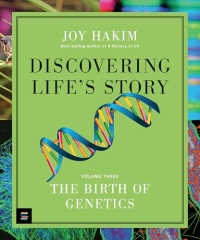
Author(s)
Publisher
Age Range
14+
Release Date
February 03, 2026
ISBN
978-1536222951
Buy This Book


Can we crack the code to life itself? In the third volume in the Discovering Life’s Story series, scientists compete to decipher the genetic blueprint behind all life on earth.

Editor review
1 review
Deep Dive into the People Behind Genetic Research
(Updated: May 19, 2026)
Overall rating
4.0
Writing Style
4.0
Illustrations/Photos (if applicable)
3.0
Learning Value
5.0
Discovering Life’s Story by Joy Hakim presents a sweeping historical narrative of the scientific quest to understand heredity, genes, and the molecular foundations of life. Rather than functioning solely as a technical explanation of genetics, the book emphasizes the personalities, careers, and persistence of the scientists who gradually uncovered the mechanisms of inheritance to which Mendel's work initially alluded.
Hakim focuses on the period beginning with the work of Charles Darwin and concluding around the 1961 meeting of the International Congress of Biochemistry. Covering 70+ years of molecular biology is an ambitious undertaking, particularly for a book marketed to teens in the 14+ age group, but Hakim limits the focus of the book primarily to the human stories behind the discoveries more so than the science itself. This is not to say Hakim entirely avoids brushing upon the technical; the sidebars and figures include chemistry, biology and vocabulary which will likely challenge even advanced high-school students in the book's target audience. Most readers not deep in the field of genetics will learn something new by looking over these figures (although, I will admit I did find the small text size in some of the figures to be better suited for the younger eyes of the target audience than they were to my own.) Yet overall these technical asides take a back seat to the personalities of those who discovered them.
A key takeaway astute young readers may notice upon reading this book is that scientific progress is often nonlinear and dependent on future generations recognizing the importance of others' preceding (or sometimes concurrent) work. When many researchers are all studying a topic in parallel, each with their own unique techniques, skill sets, and hypotheses, discovery does not look like the step-by-step linear progression that many similar books would seem to imply by focusing only on the discoveries themselves rather than the process. While a linear narrative is perhaps more satisfying and easier to follow for a (particularly young) reader, I appreciated this alternate organization that provides a more realistic insight into the scientific process.
I also applaud Hakim for shining a spotlight on the women and minority researchers who have historically been denied recognition of their contributions to our understanding in this and other scientific topics. For instance, Watson and Crick would almost certainly not be the household names they are without the work of Rosalind Franklin, who provided the photograph confirming DNA's helical shape.
One wish I had for the book would be for it to have covered the last several decades between 1961 and today. Even a short synopsis of our current understanding in the field, and an explanation of the work involved in mapping the human genome would have been a welcome addition to the conclusion of this history.
Discovering Life’s Story is a compelling account of the history of genetic discovery. Hakim’s emphasis on the human stories behind scientific breakthroughs makes the subject engaging, and offers a unique approach to telling the story of discovery - including that the process is often chaotic and non-linear. By highlighting both the triumphs and challenges faced by researchers, Hakim reminds readers that science is not merely a collection of facts, but an ongoing journey toward understanding. The technical portions of the book will be challenging for high-schoolers, but still accessible thanks to Hakim's unique way of approaching this topic. I would highly recommend it for teens considering a career in the sciences or simply looking for greater understanding of the scientific process.
Hakim focuses on the period beginning with the work of Charles Darwin and concluding around the 1961 meeting of the International Congress of Biochemistry. Covering 70+ years of molecular biology is an ambitious undertaking, particularly for a book marketed to teens in the 14+ age group, but Hakim limits the focus of the book primarily to the human stories behind the discoveries more so than the science itself. This is not to say Hakim entirely avoids brushing upon the technical; the sidebars and figures include chemistry, biology and vocabulary which will likely challenge even advanced high-school students in the book's target audience. Most readers not deep in the field of genetics will learn something new by looking over these figures (although, I will admit I did find the small text size in some of the figures to be better suited for the younger eyes of the target audience than they were to my own.) Yet overall these technical asides take a back seat to the personalities of those who discovered them.
A key takeaway astute young readers may notice upon reading this book is that scientific progress is often nonlinear and dependent on future generations recognizing the importance of others' preceding (or sometimes concurrent) work. When many researchers are all studying a topic in parallel, each with their own unique techniques, skill sets, and hypotheses, discovery does not look like the step-by-step linear progression that many similar books would seem to imply by focusing only on the discoveries themselves rather than the process. While a linear narrative is perhaps more satisfying and easier to follow for a (particularly young) reader, I appreciated this alternate organization that provides a more realistic insight into the scientific process.
I also applaud Hakim for shining a spotlight on the women and minority researchers who have historically been denied recognition of their contributions to our understanding in this and other scientific topics. For instance, Watson and Crick would almost certainly not be the household names they are without the work of Rosalind Franklin, who provided the photograph confirming DNA's helical shape.
One wish I had for the book would be for it to have covered the last several decades between 1961 and today. Even a short synopsis of our current understanding in the field, and an explanation of the work involved in mapping the human genome would have been a welcome addition to the conclusion of this history.
Discovering Life’s Story is a compelling account of the history of genetic discovery. Hakim’s emphasis on the human stories behind scientific breakthroughs makes the subject engaging, and offers a unique approach to telling the story of discovery - including that the process is often chaotic and non-linear. By highlighting both the triumphs and challenges faced by researchers, Hakim reminds readers that science is not merely a collection of facts, but an ongoing journey toward understanding. The technical portions of the book will be challenging for high-schoolers, but still accessible thanks to Hakim's unique way of approaching this topic. I would highly recommend it for teens considering a career in the sciences or simply looking for greater understanding of the scientific process.

User reviews
There are no user reviews for this listing.
Already have an account? Log in now or Create an account
Latest Additions


GET A YABC BUTTON!


We have all sorts of YABC buttons for your website. Grab one here and link to YABC!