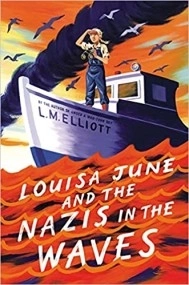
Louisa June and the Nazis in the Waves

Louisa June and the Nazis in the Waves
Author(s)
Age Range
10+
Release Date
March 22, 2022
ISBN
978-0063056565
Buy This Book
     
Days after Japan’s attack on Pearl Harbor in 1941, Hitler declared war on the U.S., unleashing U-boat submarines to attack American ships. Suddenly, the waves outside Louisa June’s farm aren’t for eel-fishing or marveling at wild swans or learning to skull her family’s boat—they’re dangerous, swarming with hidden enemies.

Her oldest brothers’ ships risk coming face-to-face with U-boats. Her sister leaves home to weld Liberty Boat hulls. And then her daddy, a tugboat captain, and her dearest brother, Butler, are caught in the crossfire.

Her mama has always swum in a sea of melancholy, but now she really needs Louisa June to find moments of beauty or inspiration to buoy her. Like sunshine-yellow daffodils, good books, or news accounts of daring rescues of torpedoed passengers.

Determined to help her Mama and aching to combat Nazis herself, Louisa June turns to her quirky friend Emmett and the indomitable Cousin Belle, who has her own war stories—and a herd of cats—to share. In the end, after a perilous sail, Louisa June learns the greatest lifeline is love.

Editor review

1 review
Tulips and Tug Boats in World War II
(Updated: July 07, 2026)
Overall rating
 
4.3
Plot
 
4.0
Characters
 
4.0
Writing Style
 
5.0
Illustrations/Photos (if applicable)
 
N/A
Louisa lives in Tidewater Virginia with her father, who is a tugboat captain, mother, who runs the family's seventy acre farm, older sister Katie, who goes to Red Cross dances to socialize with soldiers and wants to go to welding school, Will, who joins up when the war effort needs men to work on ships, and Butler, who is in high school. The Depression has been hard on the family, especially on her mother, who suffers from melancholy. Despite the hardships they face, the family is very literary, and frequently quote lines from their favorite books by the likes of Alcott (hence, Louisa's name). The East Coast has been plagued by Nazi submarines, which are attacking all manner of sea going vessels. Despite this, Louisa's father has continued his work, even engaging Butler to help when Will joins up. When a tragedy occurs, Louisa's mother doesn't handle it well, but a caring relative, Cousin Belle, steps in to help Louisa deal with the situation. When Bell and Louisa are in town on an errand near Fort Monroe, they see two ships that are hit, and see that many men are in distress. They hurray back to the house and round up everyone to take their boat to the scene, where they manage to say a young British man from the water. Will this experience help the family to deal with their tragedy?
Good Points
The details of ordinary life are so well done in this, from the family growing tulips, to the Red Cross dances, to information about scarcity of certain food products. There's even a radio chat from Eleanor Roosevelt outlining household economies that families could implement. This also covers yet another topic from this era that hasn't gotten a lot of coverage in middle grade literature-- attacks on the US. I'm sure this is more common knowledge along the East Coast, but I'd never heard or read about U Boats attacking commercial vessels. The different activities of the family members, and their relationship to each other, is also nicely done. What a difficult time. Elliot has also covered the topic of World War II in the excellent Under a War-Torn Sky (2001) which is still very popular in my library.

The mother's mental illness plays a large part in this book, and Elliott has included resources at the end of the book for readers who might need to seek help. While I wonder how prevalent mental illness was during World War II (it certainly wasn't something that was ever talked about, so I'm not sure if any statistics even exist), it is certainly a great concern today.

This reminded me a bit of Tunis' Silence Over Dunkerque (1962) in regards to the sea going rescue or Larson's Code Word Courage (2018) when it came to the homefront setting from the point of view of a young girl. Other titles, like Cushman's War and Millie McGonigle or Bunting's Spying on Miss Mueller (1995) cover different aspects of the homefront, but Louisa June's experiences with the boats set this one apart. I loved the cover on this one, but I'm curious as to whether the cover design was made to deliberately echo the cover of Barton's Dazzle Ships (2017), although that was about World War I.
Comments (0) | Was this review helpful? 0 0

User reviews

There are no user reviews for this listing.
Already have an account? or Create an account