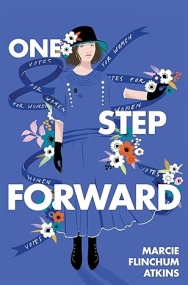
One Step Forward

Featured
715IzT1aqxL
Publisher
Age Range
12+
Release Date
March 04, 2025
ISBN
978-0063339316
Buy This Book
     
One Step Forward is a compelling debut YA historical fiction novel in verse about Matilda Young—the youngest American suffragist imprisoned for picketing the White House to demand women’s right to vote.
Raised in a politically divided family, Matilda wondered if she could be as courageous as her older sister who fought for suffrage. Joining the radical protest movement came with plenty of risk. Women were routinely scorned, harassed, arrested—and worse. And taking a stand for her rights could tear her family apart.

Told in powerful verse, One Step Forward follows Matilda's coming-of-age journey as she takes her first step into action. Amid the backdrop of World War I, Matilda’s story vividly highlights the extreme mental, physical, and emotional battles faced by the protestors leading up to the passage of the Nineteenth Amendment. It also reveals the bravery, hard work, and spirit of the women who paved the way for future generations to use their voices and votes.

Editor review

1 review
Novel in Verse about Women's Suffrage
(Updated: June 04, 2026)
Overall rating
 
3.7
Plot
 
4.0
Characters
 
4.0
Writing Style
 
3.0
Illustrations/Photos (if applicable)
 
N/A
In this novel in verse, we meet Matilda Young, the youngest of a large family living in Washington, D.C. Based on a real person, Matilda is interested in the women’s suffrage movement when the book opens in 1913. At just 14, there’s not much that she can do, and her family even forbids her from going to protest marches, although she does sneak out. While her mother and older sister Joy are very active, and her older sister Rachel has a job with Senator LaFollette on Capitol Hill, Matilda’s father does not support voting rights for women. Still, Matilda is shocked to see him at a march with his boss, drinking and making fun of the women. Her brother seems caught in the middle, but her neighbor Peter is an ally. As the years pass, Matilda is able to become more and more involved, volunteering at the Congressional Union for Women’s Suffrage, handling the mail. This gives her many opportunities to meet prominent figures in the suffragist movement like Inez Milholland and Alice Paul, as well as ordinary women like Rose Winslow who worked for years in factories and wants to help young workers get better conditions. When the U.S. enters World War I, there is some talk about cutting back on protests, but older participants regret a similar move during the Civil War. Silent Sentinals are dispatched to picket the White House every day, although public sentiment tells them not to “annoy” president Woodrow Wilson while he is dealing with the war, and they suffer frequent attacks. After securing a paying job with the National Women’s Party and being moved to working the switchboard, Matilda becomes even more involved. Her older sister, along with many others, is arrested, and kept in horrible conditions in a workhouse. The women refuse to pay fines and admit guilt. Again and again, the women protest and are arrested and abused, but they don’t give up. Eventually, the war ends, and the women’s travails pay off. 1919 is a tense year as the ratification process moves slowly through the states, but eventually Tennessee ratifies the 19th Amendment in August of 1920, and women win the right to vote.
Good Points
Each section of the book starts with a specific date, which was very helpful. This is a good outline of the different events in the movement, and watching as Matilda gets older and is able to participate more and more is interesting. Her involvement with various organizations, and her relationship with other suffragists made this quite a compelling account. There are some good notes in the back about various real life people who appear in the text; it’s sad that there isn’t more information available about Young! I love that the cover captures the essential elements of a photograph of her from this time. (Image from the Library of Congress, https://www.loc.gov/item/mnwp000066/)

The verse format leads to having to read just one word on every line, which will appeal to readers who want shorter books. I do wish there had been another subplot about other things going on in Matilda’s life; a romance or friendship with Peter would add to the appeal for younger readers.

There are few other books about suffrage; I rather regret having weeded Bolton’s 1963 Never Jam Today, but it was in very poor condition. For now, this is a good choice for readers who liked Zimet’s Roses and Radicals, Chamber’s Finish the Fight, or Kops’ exquisite Alice Paul and the Fight for Women’s Rights, but would like a fictional view of the early 19th century suffrage movement.
Comments (0) | Was this review helpful? 0 0

User reviews

There are no user reviews for this listing.
Already have an account? or Create an account