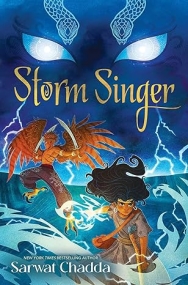
Storm Singer

81TLzaZ6KCL
Author(s)
Age Range
8+
Release Date
April 15, 2025
ISBN
978-1665962445
Buy This Book
     
Skandar and the Unicorn Thief meets One Thousand and One Nights in this thrilling middle grade fantasy from Rick Riordan Presents author Sarwat Chadda about a girl with the magical power to control the elements with her song.

In a land ruled by fierce winged warriors known as eagle garudas, twelve-year-old Nargis is just a poor, lowly human, a Worm who hates the garudas that killed her parents. But even though she can’t fly—and her childhood attempt left her walking with a crutch—she is far from powerless. Nargis is a spirit singer: able to coax small bits of wind, water, fire, and earth to do her bidding through song…well, sometimes.

When Nargis loses control of her power in a high-stakes kite fight, she is exiled. Cast into the desert, she discovers Mistral, an injured boy who turns out to be an eagle garuda, the prince of her enemies! He’s on a mission to take back his throne from a terrible vulture garuda. In spite of their mutual distrust, the two have no choice but to forge an unlikely alliance if they want to escape the desert alive.

And as Nargis and Mistral battle dangerous assassins, befriend crafty sky pirates, and sneak into the mysterious sky castle of Alamut, Nargis discovers she carries a family secret, one that could bring Monsoon’s rains back to the desert, but only if she’s willing to risk her life in the bargain…

Editor review

1 review
Learning to understand others
(Updated: June 23, 2026)
Overall rating
 
4.7
Plot
 
5.0
Characters
 
5.0
Writing Style
 
4.0
Illustrations/Photos (if applicable)
 
N/A
What worked:
The author creates an imaginative world where birdlike creatures rule over the humans. The garuda call humans Worms because they’re a lower life form, barely worth worrying about. Nargis finds an injured eagle garuda named Mistral, although she likes to call him Birdy. Raptor garudas are the most powerful, and Birdy’s father was the ruler before being captured by a vulture garuda named Shamshir. As you can see, the characters live in a caste system with humans at the bottom. Normally, characters aren’t able to move to higher caste levels, but Mistral’s father has ideas that are not popular among many garudas. The sarcastic banter between Mistral and Nargis is a highlight.
Young readers will root for Nargis, as she’s an unlikely hero. She seems feeble due to her damaged leg and the fact that she must use a crutch carved by her deceased father. She’s been ostracized from her village and lives in a small hut with her Baba. Her lone friend is Arjuna, owned by the greedy, ruthless man controlling the village. Nargis has a magical ability to control the spirits, although she still needs to learn that they can’t be ordered to help. Her songs asking for help have good intentions but the spirits don’t always act as she wants. Readers will wonder why Shamshir wants her dead once he learns Nargis’s connection to her father.
The setting is very important to the events, so readers are constantly reminded of the harsh, dry, barren lands. Nargis assumes her village is worse off than most others until she discovers they’re more fortunate. Nargis and Baba have a well that provides small amounts of water, but the stream running by the village is tainted with yellow poison. Nargis and Baba use spirit singing to help their small garden survive, but everyone else struggles for food. Nargis is banished from the village and ventures into the severe terrain, which reminds readers that it’s unforgiving. The hostile environment forces all the caste groups into competition for survival, with the strongest typically surviving.
What didn’t work as well:
The crippling of Nargis’s leg is a little confusing, as she seems to move about better than expected. The author emphasizes the pain and cramping she experiences, but she’s still able to travel across rocky, hilly terrain and scale a ladder. Also, there isn’t any technology in the book; bows, arrows, spears, and clubs are used as weapons, but Shamshir has a cannon called the Dragon. It’s powerful enough to wipe out a whole village, but its power doesn’t fit the context of the overall book.
The final verdict:
Nargis’s sympathetic character highlights the book, as her story is literally spiritual. The author saves some surprises for later in the book, as Nargis learns of her father’s history with the garudas. I recommend you give this book a shot.
Comments (0) | Was this review helpful? 0 0

User reviews

There are no user reviews for this listing.
Already have an account? or Create an account