
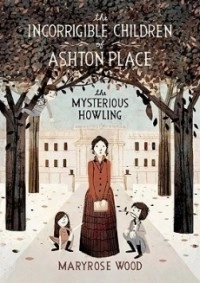
Found running wild in the forest of Ashton Place, the Incorrigibles are no ordinary children: Alexander, age ten or thereabouts, keeps his siblings in line with gentle nips; Cassiopeia, perhaps four or five, has a bark that is (usually) worse than her bite; and Beowulf, age somewhere-in-the-middle, is alarmingly adept at chasing squirrels. Luckily, Miss Penelope Lumley is no ordinary governess. Only fifteen years old and a recent graduate of the Swanburne Academy for Poor Bright Females, Penelope embraces the challenge of her new position. Though she is eager to instruct the children in Latin verbs and the proper use of globes, first she must help them overcome their canine tendencies. But mysteries abound at Ashton Place: Who are these three wild creatures, and how did they come to live in the vast forests of the estate? Why does Old Timothy, the coachman, lurk around every corner? Will Penelope be able to teach the Incorrigibles table manners and socially useful phrases in time for Lady Constance's holiday ball? And what on earth is a schottische?
- Books
- Middle Grade Fiction & Indies
- Middle Grade Fiction
- The Mysterious Howling (The Incorrigible Children of Ashton Place #1)
The Mysterious Howling (The Incorrigible Children of Ashton Place #1)
Author(s)
Publisher
Age Range
8+
Release Date
February 23, 2010
ISBN
0061791059
Buy This Book


Found running wild in the forest of Ashton Place, the Incorrigibles are no ordinary children: Alexander, age ten or thereabouts, keeps his siblings in line with gentle nips; Cassiopeia, perhaps four or five, has a bark that is (usually) worse than her bite; and Beowulf, age somewhere-in-the-middle, is alarmingly adept at chasing squirrels. Luckily, Miss Penelope Lumley is no ordinary governess. Only fifteen years old and a recent graduate of the Swanburne Academy for Poor Bright Females, Penelope embraces the challenge of her new position. Though she is eager to instruct the children in Latin verbs and the proper use of globes, first she must help them overcome their canine tendencies. But mysteries abound at Ashton Place: Who are these three wild creatures, and how did they come to live in the vast forests of the estate? Why does Old Timothy, the coachman, lurk around every corner? Will Penelope be able to teach the Incorrigibles table manners and socially useful phrases in time for Lady Constance's holiday ball? And what on earth is a schottische?

User reviews
1 review
Overall rating
4.0
Plot
4.0(1)
Characters
N/A(0)
Writing Style
N/A(0)
Illustrations/Photos (if applicable)
N/A(0)
Already have an account? Log in now or Create an account
Raised by Wolves...
(Updated: June 23, 2026)
Overall rating
4.0
Plot
4.0
Characters
N/A
Writing Style
N/A
Illustrations/Photos (if applicable)
N/A
Reader reviewed by Justine
I'm so glad I tried the first Incorrigible Children of Ashton Place novel, because this is such a quirky read and I love the
snarky, tongue-in-cheek quality of the narration (and also the
protagonist on occasion). Fifteen-year-old Penelope Lumley, newly
graduated from the Swanburne Academy for Poor Bright Females, is hired
as governess to three children belonging to Lord Fredrick and Lady
Constance of Ashton Place. Little does Penelope know that these
children are orphans Fredrick found on a hunting expedition in the
woods...and they have literally been raised by wolves. A comical slew
of mishaps ensues as Penelope endeavours to drum into the childrens'
heads everything from the poetry of Longfellow to the schottische
dance. But it seems that Alexander, Beowulf and Cassiopeia aren't the
most serious terrors lurking at Ashton Place - something is hiding in
the attic, and the coachman Old Timothy seems to be most adept at
sneaking around...
Maryrose Wood's writing style is simply wonderful. I love how the
narrator manages to poke fun while using such a prim-and-proper tone,
and the vaguely Victorian setting is charming. Almost every chapter
begins with some kind of pithy comment on life that sets up the rest of
the chapter. For instance, from Chapter 9:
If you have ever opened a can of worms, boxed yourself into a
corner, ended up in hot water, or found yourself in a pretty pickle,
you already know that life is rarely (if ever) just a bowl of cherries.
Or, from Chapter 5:
As you probably know from personal experience, there are children
who love to take baths, and there are children who absolutely do not.
Unfortunately, this is only Book 1 in a series, and the reader is left
dangling at the end of the last chapter ("to be continued...") with
none of the problems resolved (except, perhaps, that the children are a
little more educated and well-behaved than when Penelope first
arrived!) It is more the mere beginnings of a story arc than a fully
executed plot, and the feeling when the reader turns the last page is
that the book is only half-finished.
Still, it is a quick read and the tone is so priceless that I would
recommend it for that alone! The references to other pieces of
literature (Jane Eyre, A Christmas Carol, and Hamlet,
to name a few) might go over the heads of younger readers but will
amuse the older ones (and any adult readers!) Of course, since the
target audience is children there were a few scenes I am sure I would
have enjoyed more as a young reader, but on the whole it held my
attention very well. Indeed, it almost seems as though the book has
been written on two levels - one for children who will laugh at the
antics of the wolf-raised siblings, and another for the adults who will
laugh at the dry wit of the narrator and the poor plight of Penelope. I
only wish there were more of it!
I am eager to find out about what is living in the attic, not to mention who is targeting the three children... More please!
I'm so glad I tried the first Incorrigible Children of Ashton Place novel, because this is such a quirky read and I love the
snarky, tongue-in-cheek quality of the narration (and also the
protagonist on occasion). Fifteen-year-old Penelope Lumley, newly
graduated from the Swanburne Academy for Poor Bright Females, is hired
as governess to three children belonging to Lord Fredrick and Lady
Constance of Ashton Place. Little does Penelope know that these
children are orphans Fredrick found on a hunting expedition in the
woods...and they have literally been raised by wolves. A comical slew
of mishaps ensues as Penelope endeavours to drum into the childrens'
heads everything from the poetry of Longfellow to the schottische
dance. But it seems that Alexander, Beowulf and Cassiopeia aren't the
most serious terrors lurking at Ashton Place - something is hiding in
the attic, and the coachman Old Timothy seems to be most adept at
sneaking around...
Maryrose Wood's writing style is simply wonderful. I love how the
narrator manages to poke fun while using such a prim-and-proper tone,
and the vaguely Victorian setting is charming. Almost every chapter
begins with some kind of pithy comment on life that sets up the rest of
the chapter. For instance, from Chapter 9:
If you have ever opened a can of worms, boxed yourself into a
corner, ended up in hot water, or found yourself in a pretty pickle,
you already know that life is rarely (if ever) just a bowl of cherries.
Or, from Chapter 5:
As you probably know from personal experience, there are children
who love to take baths, and there are children who absolutely do not.
Unfortunately, this is only Book 1 in a series, and the reader is left
dangling at the end of the last chapter ("to be continued...") with
none of the problems resolved (except, perhaps, that the children are a
little more educated and well-behaved than when Penelope first
arrived!) It is more the mere beginnings of a story arc than a fully
executed plot, and the feeling when the reader turns the last page is
that the book is only half-finished.
Still, it is a quick read and the tone is so priceless that I would
recommend it for that alone! The references to other pieces of
literature (Jane Eyre, A Christmas Carol, and Hamlet,
to name a few) might go over the heads of younger readers but will
amuse the older ones (and any adult readers!) Of course, since the
target audience is children there were a few scenes I am sure I would
have enjoyed more as a young reader, but on the whole it held my
attention very well. Indeed, it almost seems as though the book has
been written on two levels - one for children who will laugh at the
antics of the wolf-raised siblings, and another for the adults who will
laugh at the dry wit of the narrator and the poor plight of Penelope. I
only wish there were more of it!
I am eager to find out about what is living in the attic, not to mention who is targeting the three children... More please!
G
Guest
Latest Additions










GET A YABC BUTTON!


We have all sorts of YABC buttons for your website. Grab one here and link to YABC!