
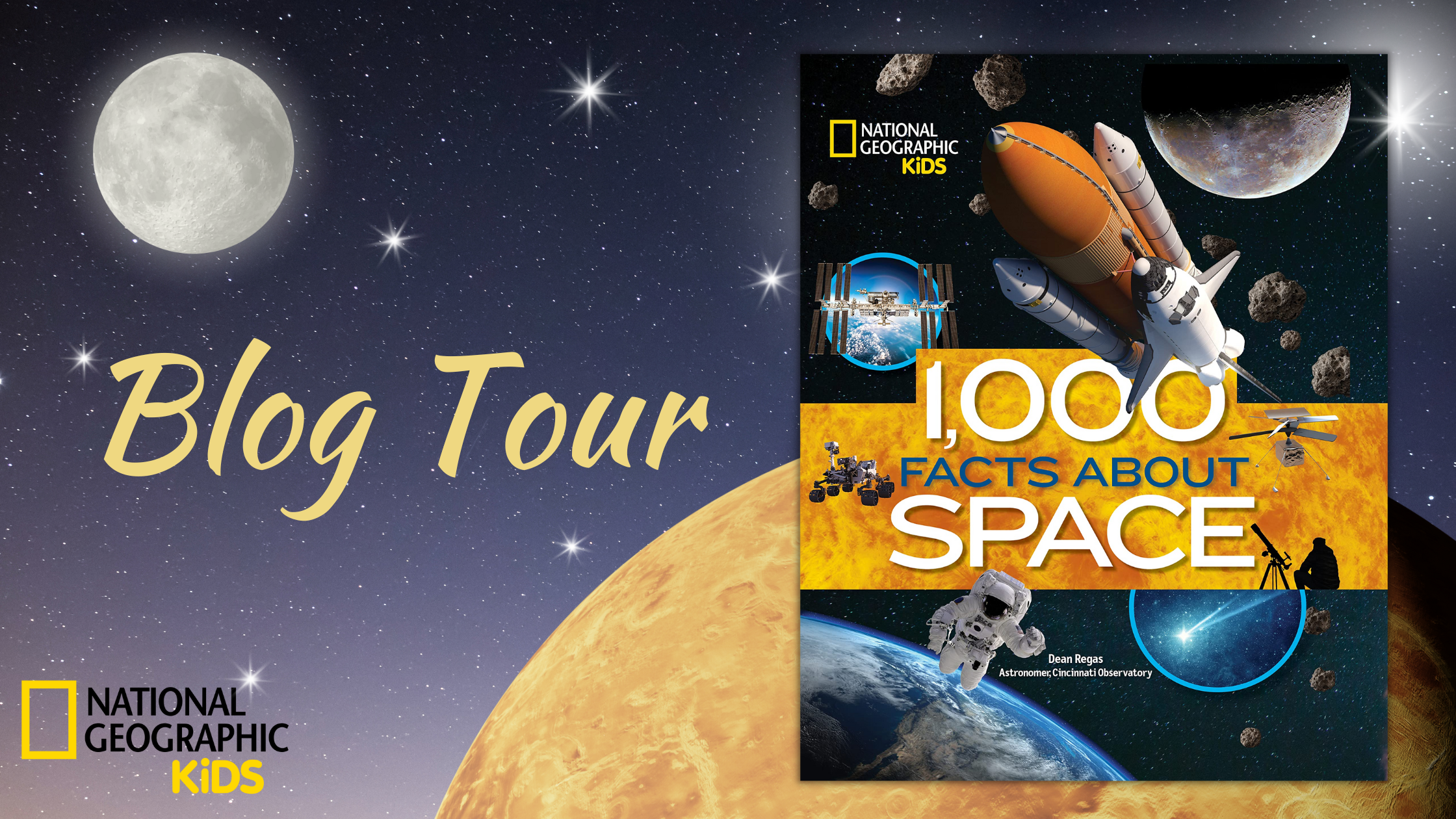
Welcome to the
1,000 Facts About Space
Blog Tour!
Get ready to blast off on an illuminating journey to the farthest reaches of the universe as we celebrate the release of the 1,000 Facts About Space (National Geographic Kids Books, ages 8-12). This week, five blogs across the web are featuring out-of-this world facts about mysterious black holes, daring space travel, groundbreaking missions, awe-inspiring stars and one of the giants of the solar system – Uranus! Looking to up your galactic IQ? Read on!
9 “Twinkling” Facts About Stars!
- Stars twinkle because their light travels trillions of miles or kilometers through space. The small amount of starlight that finally reaches Earth is easily scattered by our atmosphere.
- The North Star is also known as Polaris. Because it lies nearly above Earth’s North Pole, it does not seem to move over the course of a night. It is a year-round land-mark in the northern sky. The Southern Hemisphere does not have an equally bright and notable star marking the southern sky. There is no “South Star.”
- Earth’s axis wobbles a little over centuries, pointing the North Pole at different parts of the sky. So thousands of years ago, the star Thuban in the constellation Draco (the Dragon) was the north star instead of Polaris.
- Some types of stars, called variable stars, change their bright-ness regularly. If our sun were a variable star, it would be bright one year and dim the next.
- Various groups in the ancient world tested their eyesight using the double stars Mizar and Alcor in the Big Dipper. If you could see them both with the naked eye, you could be a scout or a hunter.
- Beta Pictoris is a very young star at only about 12 million years old. Around it, astronomers found a dusty disk of material that could hold the building blocks of future planets.
- Barnard’s Star shifts its position in the sky faster than any other star visible from Earth. It still takes hundreds of years for any change to be significant enough to notice.
- Astronomers nicknamed HD 140283 the “Methuselah star” after a very old man in the Hebrew Bible, because the star may be the most ancient ever seen—more than 13 billion years old.
- Astronomers estimate that about one septillion (1,000,000,000,000,000,000,000,000) stars could be in the observable universe.
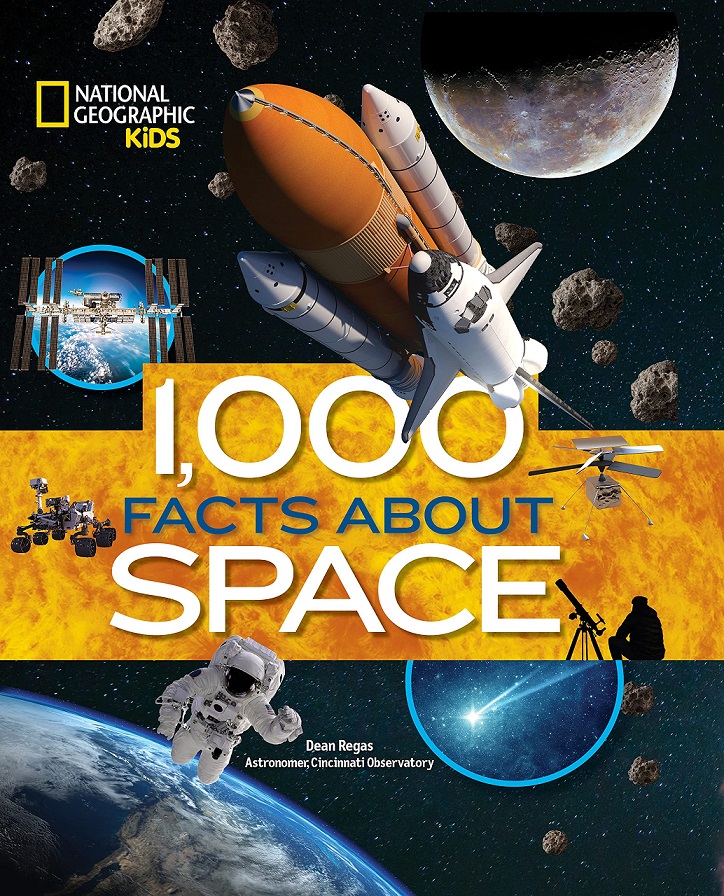
If you’d like to learn 991 MORE facts about black holes, planets, astronomers, telescopes, space travel, pioneers of space travel, space weather and so much more, check out 1,000 Facts About Space by astronomer Dean Regas.
Buy | Buy on IBookshop.org | Add to GoodReads
Did you know … that one of Saturn’s moons is so hollow it would float in water? That the largest known star is 3.69 billion times bigger than our sun? Or that Jupiter likely has diamonds floating in its clouds?
Explore dazzling facts about the vast expanse of space, from glowing stars billions of light-years away to supermassive exploding supernovas to rockets thundering into the unknown. This comprehensive book takes you on a mind-blowing tour of our unbelievable universe and is full of fascinating facts on topics such as space exploration, our solar system and galaxy, and beyond.
Expert astronomer Dean Regas ― former host of PBS’s Star Gazers and astronomer of the Cincinnati Observatory ― takes you on an incredible tour of facts about each planet in our solar system, dwarf planets, our sun and other stars, exoplanets, comets, asteroids, galaxies, space travel, and so much more. Hundreds of stunning photographs bring the facts to life.

About the Author
DEAN REGAS has been the astronomer for the Cincinnati Observatory since 2000. He is a renowned educator, author, national popularizer of astronomy, and an expert in observational astronomy.
From 2010–2019, Dean was the co-host of the PBS program Star Gazers. His books include Facts From Space!, 100 Things to See in the Night Sky, and 100 Things to See in the Night Sky, Expanded Edition. Dean is a contributing editor to Sky & Telescope magazine and a contributor to Astronomy magazine, where he won the 2008 Out-of-this-World Award for astronomy education. Dean has written more than 150 astronomy articles for the Cincinnati Enquirer, blogged for the Huffington Post, and is regularly featured on television and radio. Dean is a frequent guest on National Public Radio’s Science Friday and Here & Now. He also hosts an astronomy podcast with Anna Hehman called Looking Up. At the Cincinnati Observatory, Dean has developed his skills as a dynamic writer and public speaker who brings the complicated field of astronomy down to Earth for students of all ages. You can find him online at https://www.cincinnatiobservatory.org/dean-regas/about-dean.
Additional Resources
For additional info on the wonders of outer space, check out the kid friendly games, articles and amazing images of our galaxy and beyond at National Geographic Kids’ Passport to Space. Educators, tap into to a wealth of resources focused on space exploration, including informative videos, articles and Kahoots, at NG Education’s Resource Library.
GIVEAWAY
· One (1) winner will receive a hardcover of 1,000 Facts About Space
· US/Can only
· Ends 2/19 at 11:59 pm ET
· Enter via the Rafflecopter below
· Visit the other stops on the tour for more chances to win!
Blog Tour Schedule:
February 6th — From the Mixed-Up Files of Middle Grade Authors
February 7th — Imagination Soup
February 8th – Daddy Mojo
February 9th – YA Books Central
February 10th — Always in the Middle



























I love learning about space