Middle-Grade Review: The Greatest Stuff on Earth By Steve Tomecek


About This Book:

Have you ever stopped to think about all the stuff you encounter every day? There’s the stuff you breathe, the stuff you eat, the stuff you wear, the stuff you read, the stuff you walk on, the stuff you ride in, the stuff your body is made of… plus water, trees, sunlight, soap, electricity, vaccines, smartphones, and so much more! 

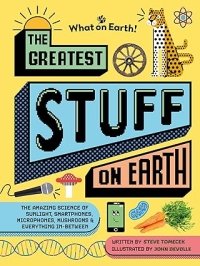
In The Greatest Stuff on Earth, Steve Tomecek and John Devolle show us how this stuff works, including the miracle of transforming energy into matter and matter into energy. Stars do it…and also internal combustion engines…and living things, including grass and bacteria and worms and cheetahs and even us humans. 

With contagiously enthusiastic and chatty explanatory text, fast facts, and clever, stylish and sometimes funny photos, illustrations, and diagrams, this fantastically browsable book offers hundreds of entry points for knowledge-hungry kids. 

Steve holds a degree in Geology and has 30 years’ experience educating children (and their teachers) about science in a super fun, friendly way – as a writer, a radio and television presenter, and a live performer. He’s the perfect person to introduce middle-grade kids to the inner workings of the material world. 

Includes a glossary and index.

*Review Contributed By Karen Yingling, Staff Reviewer*

Why can’t you trust an atom? They make up everything!

Do you have a young reader who is constantly asking “Why”? This is a great book to hand to such an inquiring mind, since it covers a lot of “stuff” in a way that is both amusing and informative.

Starting with the building blocks of “stuff”, atoms and elements, this book lays out how variety of matter and energy comes to be. I know that our sixth grade science classes talk a little about different kinds of energy, so seeing a graphic about radiant, thermal, motion, etc. types of energy, along with explanations about the differences, will be a great support for young learners. The chapters on “Nature Stuff” cover things like dirt, air, and water, but also magnets and stars.

The list of “stuff” that is made by humans starts with food, which is always appealing to kids. How many people think about if they are eating seeds, roots, stems, leaves, flowers, or fruit when they look at their daily fruits and vegetables? Not only does this talk about nutrients, but also about the different ways that food can be cooked. There are also overviews of materials that make up different things like clothing and paper, and an interesting exploration of health concerns like disinfectants, pain killers, and replacement body parts.

Good Points
There’s a great 1980s vibe to this book, with a font reminiscent of old dot matrix print, and purple, teal, coral backgrounds that make the words really pop. There’s a helpful index in the back, and I found the tables of contents to be particulary helpful.

Readers who enjoy “how stuff works” books like the National Geographic 5,000 Awesome Facts, Edge’s Quantum! The Strange Science of the Smallest Stuff in the Universe, or Davidson and Smith’s Epic FACTopia!: Follow the trail of 400 extreme facts will be enthralled with this look at the nitty gritty of the things that make up our universe.
*Find More Info & Buy This Book Here*