Today we are very excited to share an interview with author Brook M. Thompson!
Read on to learn more about the author, the book, and a giveaway!
Meet the Author: Brook M. Thompson

Brook M. Thompson is a part of the Yurok and Karuk Tribes. She is a neurodivergent and Two-Spirit author with dyslexia. She has a BS in civil engineering from Portland State University and an MS in environmental engineering from Stanford University, and she will soon have a PhD in environmental studies from University of California, Santa Cruz, where she studies water, politics, restoration, and salmon. You can find out more about her at brookmthompson.com.
Website * Instagram * BlueSky * Facebook
About the Book: I Love Salmon and Lampreys: A Native Story of Resilience
YABC: What inspired you to write this book?
There are four reasons I wrote this book:
1) Almost everyone knows what a salmon is, but lamprey is under-appreciated despite being an essential fish for the ecosystem and my tribes (Yurok & Karuk)! Lamprey are such interesting (and tasty!) fish. For example, they have a “third eye” above their head that senses changes in light like a reptile. Because they look scary with their rows of blood-sucking teeth, they are not as appreciated as they should be.
2) Growing up in the late 90s and early 2000s, I did not have many Native role models who went to college, especially not women scientists or engineers. Schools did not have many stories about Native American girls that were not set in the past. I wanted to create a book where Native students could have a role model and representation that I wish I had more access to as a child. For non-Native kids, I want to recontextualize their ideas of what an engineer or scientist looks like.
3) Growing up with dyslexia, I struggled with reading, and I struggle even now as a Ph.D. student. Reading seemed like an unfun thing, and I did not enjoy it. This book is written in a font called OpenDyslexic, which makes it easier for those with dyslexia to read the font because of how the bottom of the letters are weighted. If this book can make reading easier for a kid with a learning disability like my own, I would be thrilled.
4) I aspire to be able to tell the inspiring history of how the most significant dam removal in the US came to be, in large part due to tribal involvement.
YABC: What scene in the book are you most proud of, and why?
The scene in the book where I am in the boat on the river with my dad, my uncle Timmy, and my cousin Stormy is what I am most proud of. My Uncle Timmy and Cousin Stormy have passed on, but they were huge influences on teaching me how to fish and always supported me. All three family members helped raise me on the water, and I know they may not be able to see it for themselves, but I know they would have been proud of my accomplishments, and it is one way I can keep their spirit and passion for fishing alive!
YABC: Thinking way back to the beginning, what’s the most important thing you’ve learned as a writer from then to now?
The two most important lessons I have learned as a writer from starting my process to being published are that everything takes much more time than expected and that there is no such thing as perfect. I started writing this book in 2014 when I was a freshman in college and have been rewriting it and changing the layout of the pictures repeatedly for the last ten years. However, with the dams coming down on the Klamath finally and with a bit of support from a grant I was given from the Youth Speaks California Arts Council’s Individual Artist Fellowship Program, the time finally felt right to submit it for publishing. Even now, I can see what I would consider imperfections in the book or small things I would change, such as wording or how some pictures are laid out. However, as I grow as an author, I keep learning and improving, so nothing will ever be perfect. Sometimes, you must say it’s good enough and take the lessons learned and the energy to the next project!
YABC: What do you like most about the cover of the book?
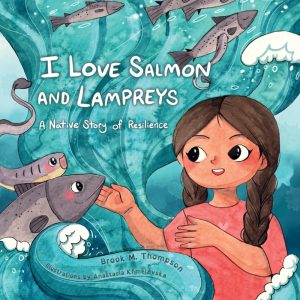
My favorite part of the front of the book is how cute and friendly the lamprey and salmon are! Lamprey can look scary if you look up real photos of them. Most people would not describe salmon as “cute”, but they are in this book! I also enjoy the watercolors on the front page and throughout the book. Watercolors were specifically chosen for the art style because it is about water in the Klamath River!
YABC: What is the main message or lesson you want your reader to remember from this book?
I hope that children will walk away from the story with hope. The lesson I would like kids to take away is that despite their generation’s environmental and climate threats, there is hope. Positive change can happen with teamwork and resistance! I also want to foster appreciation for the local tribe’s efforts in the dam removal process and understanding why they were removed. In addition, I hope those who read the book have a better appreciation for salmon and lamprey beyond seeing them as a food source. Lastly, I hope students learn that engineers and scientists also look like me! I don’t think children always think of women of color in engineering and science, so I hope some kids can see a reflection of themselves and think, “That can be me too!” Or even, “I also have a learning disability and trouble reading, but this person still wrote a book. Maybe I am not limited just because I struggle a bit.”
YABC: Do you have a playlist you listened to while writing?
I love listening to music while writing. If you look at the page where I am studying at Stanford with my cats Hahpleen (the black one, whose name means “one who brings joy” in my native language, Yurok) and Lion (the fluffy one), the page is laid out to be a homage to the Lofi Girl Youtube. I listen to Lofi music, which is instrumental electronic chill vibe music. Lofi playlists also helped me get through many late nights of engineering homework. I also play “cafe background sounds” when I am at home. Something about feeling like I am at a cafe helps me focus on the task at hand.
YABC: Do you have an unusual office supply that helps you in your writing routine?
I’m going to count slime as an office supply! Yes, slime! I have all these therapeutic slimes for adults with different textures and themes, such as soft and fluffy blue “snow fizz” slime. I use it like a fidget toy, which helps me when reviewing work.
YABC: What would you say is your superpower?
My superpower is the ability to read and write backward and upside down. Dyslexia is a condition I have. Dyslexia is a reading and writing learning disability and a neurodivergent condition that affects about 5 to 20% of the US population. Reading and writing for me is much more difficult, partially because I flip and rotate letters; however, reading and writing in different directions is much easier for me than the average person! It is my weakness and my strength! Having a neurodivergence like dyslexia also helps me see the world in a different way, which improves my science and engineering. Albert Einstein was known to have dyslexia. My book is written in a font called OpenDyslexic, which is designed to be easier to read for other kids with dyslexia. The bottom of the letters is thicker, which makes it easier for the mind to keep upright.
YABC: What’s up next for you?
My Ph.D. thesis for Environmental Studies at the University of California Santa Cruz will be the next thing I will work on! However, I have an idea for a book about local ring-tailed cats and how they are confused for lemurs. I also have ideas for more advanced levels of nonfiction writing about Native American identity politics, dam removal, and decolonizing engineering.
~ Giveaway Details ~
Three (3) winners will receive a copy of I Love Salmon and Lampreys: A Native Story of Resilience (Brook M. Thompson) ~US Only!
*Click the Rafflecopter link below to enter the giveaway*