
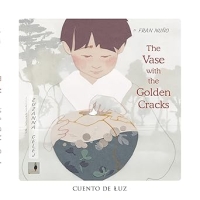
The Vase with the Golden Cracks

81sTejZrm3L
Author(s)
Co-Authors / Illustrators
  • Celej Zuzanna
Publisher Name
Cuento de Luz
Age Range
4+
Release Date
May 06, 2025
ISBN13
978-8419464958
ISBN10 or ASIN
   
In a remote part of Japan, a precious tradition is passed down from father to son.

Every day, a vase is filled with magical words.

And, like breadcrumbs marking the right path, they will guide our protagonist to find his meaning in life, or Ikigai.

But first, when the vase breaks, far from guilt or regret, the art of Kintsugi will teach him the importance of focusing on learning and the meaning of second chances.

A charming story about how much every setback in life can bring us: the magic of using golden threads to fix the scars that remind us of how much we have grown up.

An ancient tradition and a powerful philosophy are embodied in this evocative picture book, which reflects on the importance of traditions and the value of craftsmanship.

Editor review

1 review
A Beautiful Look at Words and Inspiration
(Updated: July 15, 2026)
Overall rating
 
4.3
Plot
 
4.0
Characters
 
4.0
Writing Style
 
4.0
Illustrations/Photos (if applicable)
 
5.0
The author reminisces about his father's love of words when he was growing up. The father would write his favorites on slips of paper and put them in a beautiful vase. All of the words had subtle meanings that weren't captured in any languages other than their native Japanese. One particularly inspiring word was "ikigai", which refers to one's mission in life. When the vase was accidentally broken, the father wasn't angry, but cleaned up the vase and repaired it, decorating the cracks with gold. This tradition of kintsugi embraces the scars in the pottery and shows that things are often stronger after being broken and repaired. This love of words, and the reverence shown for them, inspired the author to become an author and share his stories.
Good Points
The watercolor and collage illustrations are beautiful, and is influenced by traditional Nihonga, with many trees and natural elements. The faces remind me of some of the soft focus watercolor illustrations in early 1970s picture books as well. The use of collage is particularly striking, and many of the illustrations are framed with cut work embellishments. There is a list of Japanese words and their meanings at the end of the book, accompanied by the Japanese characters. (I'm not sure which system is used.)

This book has the most noteworthy paper of any title I have seen. It is heavy and silky, and absolutely luxurious. The publication data page describes this as Stone Paper whish is ecologically certified, and is really exceptional.

This reminds me of Reibstein and Young's 2008 Wabi Sabi, and is a great way to share aspects of Japanese culture along with Gallup's Anna's Kokeshi Dolls, Uegaki and Simms' Ojiichan's Gift, or Hadley and Fujisawa's The Star Festival.

I love words, and my favorite was Majime, a person who you trust to do any kind of job in a serious, responsible way, although many book people will love the word tsundoku. This is the act of buying more books and leaving them on the pile of OTHER books that are waiting to be read!
Comments (0) | Was this review helpful? 0 0

User reviews

There are no user reviews for this listing.
Already have an account? or Create an account