
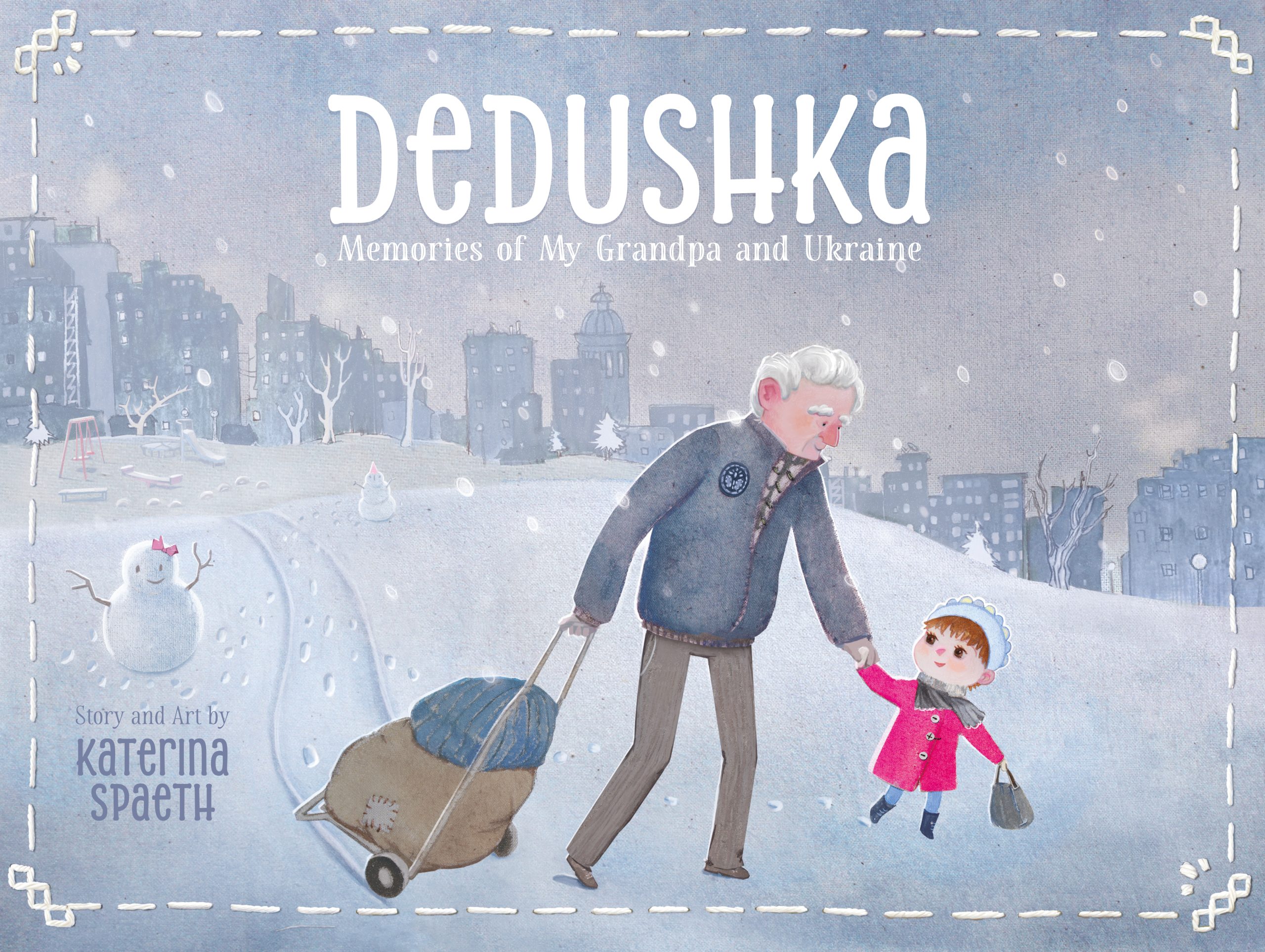
Today we are very excited to share an interview with author Katerina Spaeth!
Read on to learn more about the author, the book, and a giveaway!
Meet the Author: Katerina Spaeth
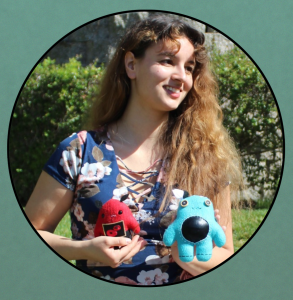
Originally from Ukraine, Katerina works and lives as a professor and artist in Northern California. She received her BFA in illustration from San Jose State in 2019.

About the Book: Dedushka: Memories of My Grandpa and Ukraine
How to protect their groceries.
How to braid flowers in her hair.
How to cook potatoes from their garden.
He taught her how to love. Family and country.
Through a series of vignettes, Dedushka pays a beautiful homage to the formative years of a Ukrainian girl’s childhood with her grandpa in the city of Kharkiv. Through soft and tender gouache paintings and embroidery, and vivid, wide-eyed prose, new talent Katerina Spaeth weaves a tender yet profound ode to her own 1990s childhood, home, and grandfather, reminding readers of what’s beautiful in life’s smallest moments.
~Author Chat~
YABC: What gave you the inspiration to write and illustrate Dedushka? As you developed your idea, did you create the illustrations first, or the story/text?
Hi, thank you so much for giving me the opportunity to tell my story!
I tend to start my projects by first writing a draft and then drawing a rough storyboard. For this story about my grandpa—Dedushka—I tried a slightly different approach. I wrote down all my childhood memories as short vignettes and then cut them out. My partner, Alex, and I arranged these strips of paper on the carpet and moved them around, trying to find the best order.
For my illustrations, I knew that I wanted to make the color palette nostalgic and I wanted to find materials and textures unique to my Ukrainian childhood. My grandpa was a military aviation engineer and after he retired he brought home a lot of sturdy burlap straps and canvas fabric. He used these materials to sew all sorts of things for the family: cat scratchers for the couch, soft cases for my grandma’s sewing needles, shopping bags… he never wanted valuable materials to go to waste. I love canvas and burlap because it’s a strong material symbolic of my grandpa and Ukraine. I used canvas in the backgrounds of my illustrations as the uniting element. I also wanted to place specific cultural elements that are recognizable to all Ukrainians so I added embroidery, which stylistically fits onto canvas. It’s easy to sew onto burlap and canvas since these fabrics have clear holes. I made stitches and embroidered sunflowers, which have become a symbol of Ukrainian solidarity during this terrible invasion.
I wrote this story to honor the history of Ukraine and the story of my grandpa. One of the questions I often get is, why is the title in Russian? I want to reassure anyone who picks up this book, that my story is not written with the intent to propagandize to anyone. The reason why the title is in Russian is simply because that is the language I learned as a child. It felt inauthentic any other way. My family has Ukrainian origins, specifically Zaporizhian Cossacks and Mariupol Ukrainian Greeks. As all Eastern Ukrainians, my ancestors were subjugated by Soviet Russia. They forced my grandpa’s generation to speak Russian. Dedushka was a native Ukrainian speaker but he did not teach his children or me Ukrainian. However, he taught me how to sing songs in Ukrainian and he introduced me to Ukrainian art, cuisine and traditions.
YABC: What research did you do to write this book?
I asked my relatives and did a lot of research into the history of Ukraine for the “My Roots” portion of the book. For the story portion of the book I tried to stay true to my own childhood memories to keep the voice intact: a child’s memory of a grandpa. I used a lot of references from family photo albums and I also went on Google Maps and I looked at various parts of the neighborhood that I grew up in because some of the photos I have don’t include certain landmarks.
YABC: What can readers expect to find in your books?
Texture. With the spread of AI art and the intense merging of creative voices into a sellable product, I want my books to have a textured feel to them. When I think about the 20th century I imagine a time capsule filled to the brim with the most intense changes that ever happened in human history. Our grandparents’ homes are a museum, a collection, and a collage. Whenever we visit the homes of older people, we are looking at a mix of textures that went from human-made, wooden, metal, intricate, and unique, all the way to plastic, industrial, and smooth. The textures of our modern world are not as alive as the textures of the past: they have become artificially perfected repeating patterns without special elements and unique mistakes. Older people’s homes are always a privilege to visit. I can’t help but think of stories from this period as collages.
When creating art I like to use clay, fabric, paper, found materials, foil—anything that I can cut up and tape down. No one can take my fingerprints out of the clay. No AI technology can mimic what is truly me as an artist. I want my books to be tactile, textural, and authentic. I want my stories to have characters that are not necessarily all good, because the best characters have a little bit of bad to them. I want my stories to shine a light on something that is not often seen, but to stay relatable. I set very high standards for all my projects and usually fall short of these high hopes, but it’s still an amazing opportunity to get to work on children’s books.
YABC: Which was the most difficult or emotional scene to write or illustrate?
Illustrating myself with Dedushka’s medals on my chest was hard. My grandpa gave so much of himself to his work and to his country, so those medals were a treasure and an honor. When he placed them on me it was like he was saying, “These are also toys, and just pieces of metal. Our time together is the most important thing.”
My grandpa was a key parental figure in my life. In Ukraine, the grandparents often take care of the children. It really does take a village. From darning a sock, to remembering stories about different family members in the family photo albums, to growing potatoes on the dacha, Dedushka taught me so much. He passed away when I was 9 years old, a year after I moved to America. As I grew up, I’ve thought back to all the lessons my grandpa taught me. I inherited my grandpa’s medals upon his passing, and as I get older, they get heavier.
YABC: What is your favorite snack when creating?
I like to eat a lot of Smarties. I stock up with a five-pound bag, so it lasts me for a couple of months. It’s the only candy I really enjoy. I think that the reason I like Smarties so much is that my grandpa and I had this little ritual where every morning he would give me one bead from a candy necklace. The beads tasted a lot like Smarties. Nowadays, whenever I eat Smarties, I feel connected to that memory. I also drink a lot of Earl Grey tea while working. I think it helps me concentrate.
YABC: If you could time travel what would you want to see?
That is such an interesting question! I used to have a list of people in my head that I called my history dates: I imagined sitting in a coffee shop with any person from history and getting to know them. If I went back into history, I would probably want to see where my grandpa grew up as a kid. He told me about horses that he had and what farm life was like. I would want to see what my grandpa and his siblings looked like as kids.
Of course, the danger of time travel, even as an observer, is that it colors your memory, removing some of the authenticity of your own recollections. Part of being native to a time and place is that you don’t have clinically academic knowledge of your environment. Instead, you have an intuitive, textural perception that comes from growing up there. A sunflower doesn’t know what field it’s in or what the name of the town is, it only knows that it’s a sunflower and it can only see as high up as a sunflower can grow. I think that if I was to go back in time, I would have to be very careful. But, I would love to see how my dedushka grew up and meet his favorite horse.
YABC: What other age group would you consider writing/illustrating for?
I think I would like to work on a graphic novel. The children’s book that I wrote for my BFA thesis, called Pali and the Patchy Monster, felt a little too long for a standard kid’s book, and I spent a lot of time indirectly complaining about the American healthcare system: that’s much too complex for the 5-8 age range. I want to write for young adults next, maybe even adults. I don’t particularly like writing about explicit topics, however I like to allude to deeper problems that are systemic to our culture, to our country, and to our world in general.
YABC: What daily thing do you see that brings you joy?
Cats! I have four of them. Near the end of this summer, my friend Lisa found a tiny, five-week old, white kitten stuck between two fences. Alex and I adopted this baby and named her Yuki. One of my cats became like a surrogate mom to her. I’m always surrounded by my cats. They jump on me, they bite me, they play with various parts of my art, which can be annoying, but it’s so cute! I take so many pictures of them.
I love that my partner works from home. I find a lot of comfort in the fact that if I need to talk to someone, they are always there for me. I also find a mix of joy and stress in the fact that I’m surrounded by hundreds of books. During COVID, I discovered there’s this website called Thrift Books, where you can buy used books and I bought so many! I feel like a corner of our apartment is a library which is very cozy but I also feel the weight of my purchasing habits and the responsibility of having to actually read all the books. I promise, one day I will!
YABC: What’s a book you’ve recently read and loved?
So, this is a book I’m still reading. It’s called The True Deceiver by Tove Jansson. Tove Jansson is an incredible writer from Finland. She’s best known as the creator of the Moomins. As a kid, I grew up reading the Russian translation of The Moomin Troll books. Now I am learning Ukrainian and I am excited to own the Ukrainian translation.
What is so phenomenal about Tove Jansson is that she writes each character without making them feel like archetypes, without making them feel like cartoons, and without flattening them. She allows each character to be as subtle, or dynamic, or changeable as real people can be. She writes them outside of the lines. Her world is Tolkien-esque in its breadth. It’s like she opens a window and you look out and it’s the same world you have seen thousands of times, but she has given you magical glasses that paint everything in a slightly surreal but more believable way. What is so inspiring to me is that Tove Jansson spent half of her life writing and illustrating for children, and then in her fifties, she switched gears and started writing for adults. Her fictional and non-fictional works for adults are so perceptive. I read her work slowly because there is so much quietly happening and I don’t want to miss anything.
YABC: What is your favorite illustrating and writing space or routine?
I like to write in coffee shops, especially if there are other people working around me. I like to work near Alex and bounce ideas back and forth. I’m not proud of my illustration routine or rather the lack of it. It would be better if I illustrated in the morning light, but unfortunately I work best at night. The hanging light over the circular table next to the kitchen where I work, shows only the things that I need to work on and all my distractions (except for the cats), fall away into the darkness. The night is quiet and peaceful, so I can lock into a state of flow and work and work and work. Unfortunately, this means that I often work best from 9 p.m. to 3 a.m., sometimes even into the wee hours of the morning.
To me, writing is for the day and art is for the night.
YABC: Part of the proceeds of Dedushka will go to supporting Nova Ukraine a 501(c)(3). Can you share why you chose this organization and describe it’s mission and why it’s close to your heart?
I chose Nova Ukraine because it’s a large and well-known humanitarian organization with multiple chapters and offices (both in the US and Ukraine), and high ratings in transparency. Nova Ukraine means “New Ukraine” and its mission is to help families, children and animals. I feel like there’s so many parts of life that war disrupts, and Nova Ukraine tries to lessen the chaos and alleviate the pain in all areas of Ukrainian life.
I also would like to use this opportunity to provide a bit of information about two other Ukrainian organizations that I donate to each month. One is called Shelter Ugolyok: Animal Rescue and Farm Sanctuary—an incredible organization that helps animals (both pets and cattle) that have been left behind during the war. The other one specifically rehabilitates bats, it’s called Ukrainian Bat Rehabilitation Center. I feel like animals are the first victims and the last to be cared for in times of crises, and I want that to change! Animals are very close to my heart.
YABC: What’s up next for you?
I would like to keep writing and illustrating children’s books. I would also love to create interactive toys. I’m learning more about the way machines work and I’m really inspired by the Maker Faire and maker toys.
I want to create surreal, strategy-based board games with my partner and maybe eventually a video game. I have painted a mural before and now I want to create larger, more engaging artworks—I am inspired by the interactive art exhibits of Yoko Ono and Yayoi Kusama. I am going to continue to teach art and will keep learning as I go.
Title: Dedushka: Memories of My Grandpa and Ukraine
Author: Katerina Spaeth
Illustrator: Katerina Spaeth
Release Date: September 16, 2025
Publisher: Paw Prints Publishing
ISBN-13: 978-1223188973
Genre: Children’s picture book
Age Range: Reading age 6-8 years
~ Giveaway Details ~
Two (2) winners will receive a copy of Dedushka: Memories of My Grandpa and Ukraine (Katerina Spaeth) ~US Only!

















How lovely this sounds!