

Today we’re spotlighting The Fight of Our Lives: AIDS in America by David Levithan and Gabriel Duckels!
Read on for more about the authors, the book, plus enter the giveaway!
About the Author: David Levithan
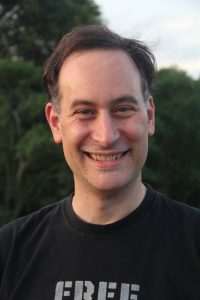
David Levithan is the author of several books for young adults, including Lambda Literary Award winner Two Boys Kissing; Every Day; Nick & Norah’s Infinite Playlist and Dash & Lily’s Book of Dares (co-authored with Rachel Cohn); Will Grayson, Will Grayson (co-authored with John Green); and Boy Meets Boy. In 2016, David received the Margaret A. Edwards Award for his significant and lasting contribution to young adult literature.
About the Author: Gabriel Duckels

Gabriel Duckels is a writer and scholar based in Austin. He holds a PhD in Education from the University of Cambridge and teaches at Texas State University.
About the Book: The Fight of Our Lives: AIDS in America
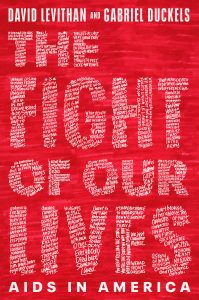
A thoughtful, poignant look at the AIDS crisis in the United States that includes primary source interviews, history, medical research, and cultural touchpoints.
The AIDS crisis in America is complex and composed of countless individual stories of grief, love, and advocacy. Its history shows the power of youth activism, how creativity and community can be vehicles for social change, and how bigotry and misinformation led to inequality in care.
The early days of the AIDS crisis saw LGBTQ+ and other marginalized communities making strides in the fight for equality. As many people in positions of power were slow to act or actively didn’t pay attention until their own communities were affected, the fight for equality turned into a fight for their lives. Grassroots efforts filled in gaps where mainstream medicine and politics failed, and over time, a cultural shift of awareness emerged, which led to more research and more treatments. And while the disease has transitioned from a death sentence to one that people can live full lives with, there are still people dying of HIV/AIDS today because they can’t access the care they need. The fight may have begun decades ago, but is not yet over.
Award-winning author David Levithan and University of Cambridge PhD Gabriel Duckels detail a brief history of the epidemic, touching on key moments and figures, such as Ryan White, ACT UP, Larry Kramer and Anthony Fauci, Pedro Zamora from MTV’s The Real World, and the Names Quilt. Threaded throughout are poems, essays, and other creative works, in addition to first-person interviews and narratives. The most important takeaway is that we must remember. We need to know what happened and why. Our voices are powerful, and they can make a difference.
~Excerpt~
The Names
For a candlelight vigil in 1985, activist Cleve Jones asked those attending to bring small handwritten placards bearing the names of people who’d died because of AIDS. As the vigil passed the San Francisco Federal Building, marchers affixed these names to a wall. Seeing the squares of names assembled in this way, Jones was reminded of a quilt—all the separate pieces coming together in one powerful whole. It felt to him like a meaningful way to assemble the dead, to commemorate their lives and protest their deaths.
His idea became the NAMES Project. Jones and others put out a call for people who’d lost someone to AIDS to create a fabric panel, three feet by six feet, in some way marking that person’s life. The NAMES Project set itself up in a storefront in San Francisco’s Castro neighbor- hood, with the plan of joining the panels together into one large quilt.
The volunteers in that Castro storefront started with one sewing machine.
They would soon need many, many more.
Within weeks, panels were coming in from all over the country. Volunteers worked well into the night sewing them together, while at the same time reading the stories sent in with the panels about the people whose lives had been lost. The AIDS Memorial Quilt had, in a simple yet striking way, tapped into one of the greatest despairs that comes with grief—the despair that the dead will be forgotten, that your memo- ries are the only things that will hold your loved one’s name onto this earth. The Quilt was not only offering a place in history, it was offering company within that place—a memorial carved not out of impersonal, graveside stone, but drawn from all the fabrics that life could hold.
Anything that could be affixed onto a square was affixed onto a square. Mementos and symbols. Sequins and denim. Favorite T-shirts and childhood blankets. Vinyl records and gold necklaces. Costumes from stage productions and pockets holding ashes. Poems and flowers, in-jokes and nicknames. Pieces of opera house curtains and wartime flags. There for everyone to see: The names of the dead. The dates of their births. The dates of their deaths. The total years they had been given to live. From four months old to seventy years old. Worldwide celebrities and those who were buried in paupers’ graves. All genders, all races. All having one devastating thing in common.
All across the country, they stitched. All around the world, they sewed.
A mother who’d watched one, then two of her sons die, putting them both on a single panel, because she knew that was what they would have wanted.
A twenty-one-year-old with AIDS creating a panel for his friend, knowing that one day soon, he would be getting a panel of his own. Then, after he died, another friend taking up the task and making that panel before he, too, died, to be stitched into the Quilt by someone else. Family and friends coming together to commemorate someone they loved, each one taking a letter in his name, each using a fabric
that reminded them of a time they’d shared with him—holidays they’d taken, shirts they’d worn together, love letters duplicated, their hand- writing transformed into black thread.
A proud sister creating a panel in her younger brother’s memory, only to have her parents insist that she cross out his last name so no one would have to know how their son died.
Other panels: anonymous. Out of fear. Out of desire to keep private things private. One daughter simply stitching Love You, Dad—because he had never wanted to talk about having AIDS and wouldn’t have wanted his name to be there.
The entire display department of a department store coming to- gether to sew panels for coworkers who’ve died. Later, the store will feature these panels in their windows as a show of support.
A man commemorating “the twelve men I expected to grow old with” by portraying them as twelve candles. Three remain lit. Nine have been snuffed out. (A year later, two more are gone.)
A teenage girl who reads in a newsmagazine about a man who died all alone, so she wants to create a panel for him, just in case no one else in his life would.
A woman who can’t bear the thought of erasing a friend’s name from her address book, so instead she cuts it out and sews it onto her piece of his Quilt.
Civil rights icon Rosa Parks creating a square for a friend, Deborah Haynes, who was one of the many people in her Black community who died because of AIDS.
Future Speaker of the House Nancy Pelosi reading out loud the name of her beloved niece as that niece’s part of the Quilt is unveiled for the nation to see.
A grandmother sewing patch after patch after patch onto a panel for her thirty-seven-year-old grandson. “We were so close,” she tells the NAMES Project. “I was there when he was born, and I was there when he passed away.”
A man who made an annual Valentine’s Day portrait of his lover asks in his dying days to be propped against the wall so his outline can
The Names | 329
be traced; after the lover’s death, the man transfers the silhouette onto fabric, surrounding it with a multitude of small words telling their story.
On and on and on. Panels for children. Panels for parents. Panels for lovers, friends, coworkers. Panels for strangers. A panel for the near stranger who died in the hospital bed next to yours. A panel for the man next door, whose name you never knew. A panel for a musi- cian whose piano playing brought you joy in low moments. Panels for drag queens using their drag names. Panels for drag queens using their offstage names. Panels for Republican politicians who never admitted what they were dying of. Panels for mentors, teachers, choir directors. Panels for men who lived on ranches. Panels for women who lived in ranch houses. Panels for those who died alone. Panels for those who died hearing voices that offered love, thanks, and release.
In 1987, in time for a giant queer march on Washington, DC, the Quilt is first shared on the National Mall, with 1,920 panels. It covers two city blocks’ worth of space. It is a public catharsis and a political reckoning as the names are read aloud and the Quilt is revealed. People weep to see the names of those they’ve known, and they weep to see the expanse of names they never knew.
In 1988, the Quilt returns with 8,288 panels. In 1992, 12,000. In 1996, it is 40,000 panels strong, covering all eleven blocks from the Washing- ton Monument to the US Capitol. An estimated 1.2 million people go to see it, including, for the first time, the president of the United States. In 2012, it is displayed in increments of 1,500 panels a day because the Quilt has become too large to show all at once.
It now has over 50,000 panels and continues to grow. It covers 1.3 million square feet.
Parts of the Quilt still travel the country, and the entire Quilt can be seen at aidsmemorial.org/interactive-aids-quilt.
As was intended, the names live on.
Title: The Fight of Our Lives: AIDS in America
Author: David Levithan and Gabriel Duckels
Release Date: 4/21/2026
Publisher: KNOPF BOOKS FOR YOUNG READERS
ISBN-13: 9780593710920
Genre: Young Adult Nonfiction – Health & Daily Living – Diseases, Illnesses & Injuries, United States, LGBTQ+
Age Range: 14 and Up
*GIVEAWAY DETAILS*
Use the Rafflepress Form below to enter
*be sure to include complete mailing address for the second entry question to qualify to win*
Five (5) winners will receive a hardcover copy of The Fight of Our Lives: AIDS in America (David Levithan and Gabriel Duckels) ~ US ONLY!

























The scourge of AIDS has taken far more lives and created more havoc than anyone could have anticipated. Thanks for writing about this important subject. 🙂
I cannot wait to get my hands on a copy of this book!!!
I think this cover is incredibly powerful because the handwritten words and bold red background immediately capture the pain, resilience, and humanity behind the AIDS crisis.