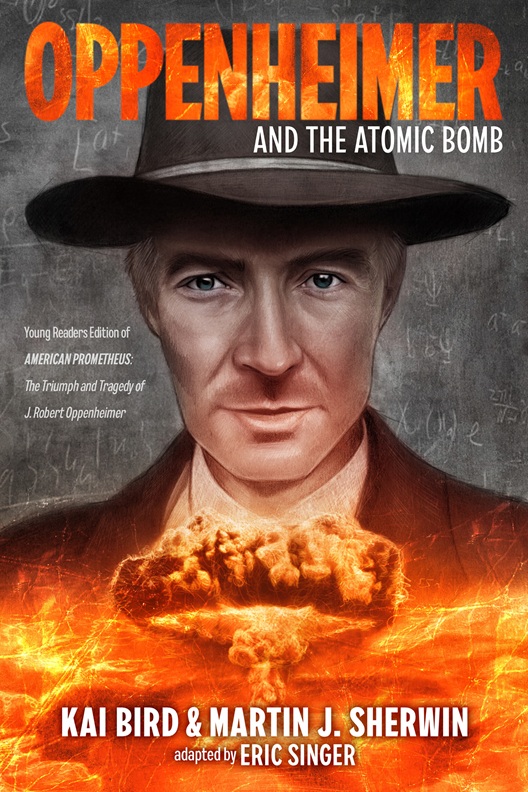
Today we’re spotlighting Oppenheimer and the Atomic Bomb Young Readers Edition of AMERICAN PROMETHEUS: The Triumph and Tragedy of J. Robert Oppenheimer by Kai Bird and Martin J. Sherwin, Adapted by Eric S. Singer!
Read on for more about the author and the book!
About the Author: Kai Bird
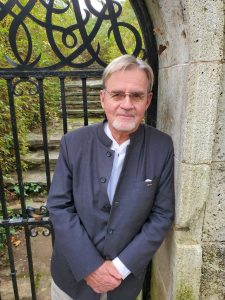
KAI BIRD is an award-winning historian and journalist. Executive Director of the Leon Levy Center for Biography, he is the acclaimed author of biographies of John J. McCloy, McGeorge and William Bundy, Robert Ames, and President Jimmy Carter. He won the Pulitzer Prize for Biography for American Prometheus: The Triumph and Tragedy of J. Robert Oppenheimer (co-authored with Martin J. Sherwin), which was adapted into the Academy Award-winning film Oppenheimer. His work has been honored with the BIO Award for his significant contributions to the art and craft of biography. He has also written about the Vietnam War, Hiroshima, nuclear weapons, the Cold War, the Arab-Israeli conflict, and the CIA. He lives in New York City and Washington, D.C., with his wife, Susan Goldmark.
About the Author: Martin J. Sherwin
MARTIN J. SHERWIN (1937–2021), distinguished historian and writer, was the author of A World Destroyed: Hiroshima and Its Legacies, which won the Stuart L. Bernath Prize, the American History Book Prize, and was a finalist for a Pulitzer Prize. After twenty years of research, he joined with Kai Bird to complete the award-winning biography, American Prometheus: The Triumph and Tragedy of J. Robert Oppenheimer. His last book was Gambling with Armageddon: Nuclear Roulette from Hiroshima to the Cuban Missile Crisis. Sherwin served on the faculty of the University of California at Berkeley, Princeton University, the University of Pennsylvania and Dartmouth College. As the Walter S. Dickson Professor of English and American History at Tufts University for nearly 25 years, he founded the Nuclear Age History and Humanities Center there. In the last decade of his life, he was a University Professor at George Mason University and worked with the Wilson Center’s History & Public Policy Program in Washington, DC, to develop the “Nuclear Boot Camp,” a program to support young scholars of nuclear history.
About the Author: Eric S. Singer
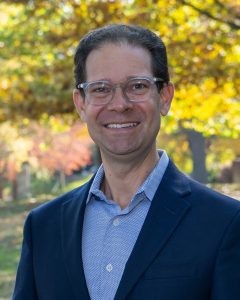
ERIC S. SINGER is a high school and university educator, and historian of the Cold War in the United States. He served on the faculty of the University of Baltimore, where he taught about the Cold War’s impact on ordinary Americans’ lives, and other social, political, and structural forces that shaped American culture over four centuries. He previously adapted Oliver Stone and Peter Kuznick’s The Untold History of the United States. His work has been featured in Hamburg Institute for Social Research’s Angst im Kalten Kreig (Fear in the Cold War), Urban History, The Nation, The Baltimore Sun, San Francisco Chronicle, Teen Vogue, and The Baltimore Banner. He lives outside Washington, D.C., with his wife, daughter, and dog, Umji.
About the Book: Oppenheimer and the Atomic Bomb: Young Readers Edition of AMERICAN PROMETHEUS: The Triumph and Tragedy of J. Robert Oppenheimer
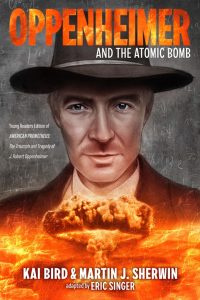
A young readers edition of the #1 New York Times bestselling, Pulitzer Prize-winning book American Prometheus was the inspiration for the blockbuster film, Oppenheimer.
This brand-new edition introduces the next generation to one of the twentieth century’s most iconic and complex global figures.
J. Robert Oppenheimer was a brilliant physicist who led the American effort to build the atomic bomb during World War II, and who later found himself confronting the moral consequences of the revolutionary weapon he helped create.
Readers of all ages will witness the rise and fall of a scientific and historical icon in this masterful new edition. Exploring his childhood, his secret work on the bomb, his central role in the Cold War, and his tragic downfall, this quintessential biography is history at its finest. Filled with dozens of photographs and updated information, this riveting and deeply informative account is now available to a middle and high school audience.
~Excerpt~
CHAPTER FIFTEEN
The Manhattan Project
“He’s a genius. A real genius.” —General Leslie R. Groves
“He couldn’t run a hamburger stand.” —Berkeley scientist
The project to build the bomb was formally called the Manhattan Engineer District. Most called it the “Manhattan Project.” The army put Colonel Leslie R. Groves in charge. Groves didn’t want anything to do with another massive army project. He had just finished work building the Pentagon and wanted to finally get out of Washington. But the army convinced him that if he did this job right, it would win the war. They promised they would make him a general.
The son of a Presbyterian army chaplain, Groves had studied engineering at the University of Washington and MIT. He graduated fourth in his class at West Point. Men serving under him grudg- ingly admired how smart he was, and how able he was to get things done fast. He was demanding, critical, abrasive, and sarcastic. He didn’t take any nonsense. Many people hated his guts. But they understood why he behaved the way he did.
On September 8, 1942, General Groves took control of the Manhattan Project. That same day, he arranged to buy twelve hundred tons of uranium. The next day, he ordered the purchase of a site in Oak Ridge, Tennessee, where the uranium could be processed.
On October 8, 1942, Groves met Robert Oppenheimer.
Groves was immediately impressed. “He’s a genius,” Groves said. “A real genius. While Lawrence is very bright, he’s not a genius, just a good hard worker. Why, Oppenheimer knows about everything. He can talk to you about anything you bring up. Well, not exactly. I guess there are a few things he doesn’t know about. He doesn’t know anything about sports.”
Robert told Groves that to build the bomb properly, they had to bring together a key group of scientists at one central location—a new lab. The lab needed to be isolated in a rural area rather than in a large city for safety reasons. Groves liked the idea immediately because it would be easier to keep the project secret.
A week after their first meeting, Groves flew Robert to Chicago, where they continued to New York aboard a luxury passenger train. On board, they continued to talk. By then Groves already had Robert in mind to direct the new laboratory. But there were three drawbacks to choosing him. First, Robert lacked a Nobel Prize, and Groves thought that might make it difficult for him to direct other scientists who had won one. Second, he didn’t have any experience leading a project like this. And third, “[his political] background included much that was not to our liking by any means.”
For those reasons, nobody else imagined that Groves would approve Robert for the job. “It was not obvious that Oppenheimer would be director,” Hans Bethe noted. “He had . . . no experience in directing a large group of people.” Robert’s great friend and admirer I. I. Rabi also thought him a strange choice: “He was a very impractical fellow. He walked about with scuffed shoes and a funny hat and he didn’t know anything about equipment.” One scientist remarked, “He couldn’t run a hamburger stand.”
But after a few weeks, Groves knew he wasn’t going to be able to find a better candidate and hired Robert to direct the project. Rabi, who didn’t like Groves, grudgingly admitted that the appointment “was a real stroke of genius on the part of General Groves, who was not generally considered to be a genius I was astonished.”
“THIS IS THE PLACE.”
Robert had always wanted to combine his passion for physics with his fierce attraction to the desert high country of New Mexico. Now he had his chance. On November 16, 1942, he and Edwin McMillan, another Radiation Laboratory physicist, set out with army major John H. Dudley to Jemez Springs, a deep canyon forty miles northwest of Santa Fe. Dudley had already inspected many possible sites across the Southwest for the secret laboratory and decided that Jemez Springs would be the best place.
But when they arrived, Robert and McMillan began arguing with Dudley that the snake of land at the bottom of the canyon was too narrow and confined. To house the scientists, their families,
army people, and their families, they needed enough open space to build a whole town from scratch.
Robert complained that Jemez Springs had no view of the magnificent mountains. The steep canyons would also make it impossible to fence in. “We were arguing about this when General Groves showed up,” recalled McMillan. Groves took one look at the site and said, “This will never do.” He turned to Robert and asked if he knew of a better location.
Robert knew the perfect location. “If you go on up the canyon, you come out on top of the mesa and there’s a boys’ school there which might be a usable site.” Exasperated, the men piled back into their cars and drove northwest about thirty miles across a lava mesa called the Pajarito Plateau.
In late afternoon, they pulled up to the Los Alamos Ranch School. Through the haze of drizzly snowfall, Robert, Groves, and McMillan saw a group of schoolboys out on a playing field run- ning around in shorts. The school’s eight-hundred-acre grounds included the “Big House,” its main building; Fuller Lodge, a beautiful manor house built in 1928 from eight hundred ponderosa logs; a rustic dormitory; and a few other smaller buildings. Behind the lodge there was a pond that the boys used for ice skating in the winter and canoeing during the summer. The school stood at an elevation of seventy-two hundred feet, just about at timberline. To the west, the snowcapped Jemez Mountains rose to eleven thousand feet. From the spacious porch of Fuller Lodge, one could look forty miles east across the Rio Grande Valley to the majestic Sangre de Cristo mountain range, rising to a height of thirteen thousand feet. Groves suddenly announced, “This is the place.”
Title: Oppenheimer and the Atomic Bomb Young Readers Edition of AMERICAN PROMETHEUS: The Triumph and Tragedy of J. Robert Oppenheimer
Author: Kai Bird and Martin J. Sherwin, Adapted by Eric S. Singer
Release Date: 5/13/25
Publisher: G.P. Putnam’s Sons BFYR
Genre: Biography & Autobiography, Science & Technology, Nonfiction, History, United States, 20th Century, Military & Wars, Biography & Autobiography, History & Social Studies, Government & Politics, Courage & Honor
Age Range: 10 and up