
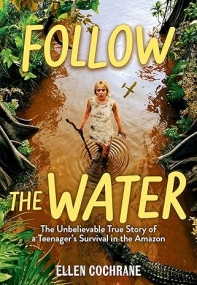
Follow the Water: The Unbelievable True Story of a Teenager's Survival in the Amazon

 
4.0 (2)
 
5.0 (1)
1903 0
91Uw5We5odL
Age Range
10+
Release Date
March 17, 2026
ISBN
978-1523528639
Buy This Book
     
A captivating and incredible true story about a girl who fell out of a plane over the Amazon—and walked out of the jungle eleven days later, perfect for fans of Hatchet and graduates of the I Survived series.

On Christmas Eve 1971, seventeen-year-old Juliane Koepcke and her mother boarded a plane in Lima, Peru, bound for their home at the Panguana Research station deep in the Amazon. Twenty minutes from landing, the plane was struck by lightning, and Juliane hurtled two miles down through the rainforest canopy, crashing on the jungle floor.

She woke up the next day with a broken collarbone, missing her glasses and one shoe, but incredibly, miraculously, alive. Pulling on every bit of knowledge her rainforest-studying parents imparted to her, she journeyed through the danger-filled jungle for eleven days. She was the sole survivor.

Complete with sidebars that explore and explain the science that allowed Juliane to survive her fall, the diversity of life in the Amazon jungle, the natural history of Peru and much more, Follow the Water is a powerful and unforgettable true story of survival against all odds.

Editor reviews

2 reviews
Truth is stranger than fiction!
(Updated: June 12, 2026)
Overall rating
 
4.0
Writing Style
 
4.0
Illustrations/Photos (if applicable)
 
4.0
Learning Value
 
4.0
Julianne Koepcke's survival in the Amazon after a plane crash in 1971 is a riveting story that has been covered before in Olson's 2018 Lost in the Amazon: A Battle for Survival in the Heart of the Rainforest as well as her own 2012 memoir When I Fell from the Sky: The True Story of One Woman's Miraculous Survival. Follow the Water frames this true story in a way that will appeal to middle grade readers, with details about Koepcke's life before and after this tragic event and a lot of additional information about a variety of topics, such as wildlife in the Amazon, rainforest leaves, and bacteria and viruses.

Raised by biologist parents in Peru, in a remote research facility dubbed "Panguana", Juliane learned a lot about her environment and how to survive in it. When she reached high school age, she was required to attend a school in Lima. Right before Christmas in 1971, her mother visited her, and the two got on a small plane to return home.

When the plane went down, Juliana fell two miles to Earth, but sustained relatively few injuries. This was because her airplane seat was attached to another, so fell in a manner similar to a maple tree seed, which slowed her down, and she then fell through densely packed liana vines. She had a spinal cord injury and a broken collar bone, and ended up with just her dress, one shoe, and a handful of food she was able to find in the wreckage. Heeding her father's advice that she "follow the water", she traveled down the river despite her injuries. She was fairly fortunate that she was not attacked by any animals, although she did have maggots in her wounds and ended up with an infection from drinking the water. After eleven days, she came across a boat that she thought about taking, but also found a cabin and some woodcutters, who were very surprised to see her but took good care of her and helped her get to safety.
Good Points
After this experience, Koepcke continued her studies. She worked as a librarian in Munich and eventually followed in her parents' footsteps to protect the Peruvian wilderness, often facing political difficulties. She specializes in bats, and continues to advocate for the rainforest.

I loved the factual details sprinkled throughout the book, but my favorite concerned the filmmaker Werner Herzog, who adapted her story into the 1998 film Wings of Hope. He had a personal connection to her story because he and his crew were waiting in line at the same airport as Koepcke but were unable to get on the flight, saving their lives!

The research that Cochrane did is extensive, and there is a great list of sources that includes books as well as multiple web sites. The story moves quickly, and has just enough detail about the events before and after the crash to add an extra level of interest. Hand this to readers who like true survival tales like Sole Survivor by Norman Ollestad or fictional ones like Into the Rapids by Anne Braden.
Comments (0) | Was this review helpful? 0 0
A Compelling Survival Story
(Updated: June 12, 2026)
Overall rating
 
4.0
Writing Style
 
4.0
Illustrations/Photos (if applicable)
 
N/A
Learning Value
 
4.0
What worked:
The story is told using present-tense verbs, so readers will feel like the events are happening right then. The book opens with background information describing Julianne’s formative years. This section is important as it shows where she acquired most of her survival knowledge. “Normal” teenagers would probably perish in the Amazon jungle. Julianne’s parents study Amazonian flora and fauna, and they built a home in the jungle to support their work. Julianne spends most of her formative years in the Amazon, and her father teaches her about plants she can eat and dangers she should avoid. Following the water is an important survival skill he shares, since moving water will eventually lead to humans.
Sidebars are found in each chapter, and they present information relevant to Julianne’s situation. The first question readers will have is how a girl can still be alive after falling into a dense jungle from two miles in the sky. The book shares a scientific explanation. Hungry predators are a constant danger, so the book offers information about piranhas, jaguars, caimans, giant spiders, and various insects, including the screwworm fly. There’s even a part about the harmful effects of eating too much after starving for days. Julianne suffers from many severe injuries, and readers might wonder why she doesn’t succumb to the pain. The book provides information on how the human body responds to severe trauma and stressful situations. Some of the effects aren’t felt until several years pass. Pages at the end of the book share additional material related to the Amazon and how to become a scientist.
What didn’t work as well:
For the most part, middle-grade readers can appreciate Julianne’s ordeals. Some of the descriptions are graphic, especially when screwworm flies lay eggs in her open wounds. Julianne faces harrowing dangers in the jungle, but there’s not a moment when readers will feel her death is imminent. That’s probably due to her superior survival knowledge.
The final verdict:
The edition I read did not have illustrations; the final version will have them. The book augments Julianne’s dramatic adventure with facts to describe jungle hazards and the science of her survival. The tale is even more amazing when readers understand that everything described happened to a real, living teenager. I recommend you try the book for yourself.
Comments (0) | Was this review helpful? 2 0

User reviews

1 review
Overall rating
 
5.0
Writing Style
 
5.0(1)
Illustrations/Photos (if applicable)
 
5.0(1)
Learning Value
 
5.0(1)
Already have an account? or Create an account
my jaw is still on the floor
(Updated: June 12, 2026)
Overall rating
 
5.0
Writing Style
 
5.0
Illustrations/Photos (if applicable)
 
5.0
Learning Value
 
5.0
I’ve officially found the ultimate survival mode inspiration, and suddenly my DIY projects don't feel quite so high-stakes!

I read Follow the Water by Ellen Cochrane, and my jaw is still on the floor. Imagine it’s Christmas Eve, 1971. You’re seventeen, your plane is struck by lightning, and you literally hurtle two miles down into the Amazon rainforest. This isn't a movie plot, it's the actual true story of Juliane Koepcke.

She woke up with a broken collarbone, one shoe, no glasses, and the realization that she was the only survivor. For eleven days, she used every bit of jungle-smarts her parents ever taught her to trek through one of the most dangerous places on Earth.

The book is packed with super cool sidebars about the science of her fall and the wild biodiversity of Peru, making it feel like a leveled-up version of the I Survived series we all loved. It’s harrowing, it’s educational, and it’s a massive testament to human perseverance. If you loved Hatchet, you need to read this immediately!
Comments (0) | Was this review helpful? 0 0