
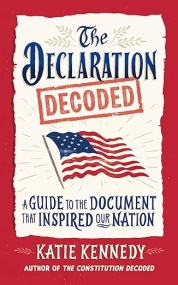
In the style of Katie Kennedy’s acclaimed THE CONSTITUTION DECODED and THE PRESIDENTS DECODED, this fascinating book goes through the Declaration sentence by sentence and idea by idea. Readers will gain a deep understanding of not only the basic meaning of the Founders’ now-arcane language, but the historical background against which the Declaration was written, the situations that animated it (especially its 27 distinctly modern “grievances” against King George III), and the powerful arguments it makes about government, rights, responsibilities, and freedoms—arguments that we’re still having 250 years later. (They'll also discover fun facts: That "unalienable" was probably a typo!) An essential guide for any student or teacher of civics and American history, or any patriotic American, THE DECLARATION DECODED brings this powerful text to life for a new generation.
- Books
- Middle Grade Non-Fiction
- The Declaration Decoded
The Declaration Decoded
Author(s)
Publisher
Age Range
10+
Release Date
May 26, 2026
ISBN
978-1523535200
Buy This Book


“We hold these truths to be self-evident, that all men are created equal; that they are endowed by their creator with certain unalienable rights; that among these are life, liberty, and the pursuit of happiness. . . .” So begins the Declaration of Independence, the fabled 1776 document in which a group of men in a distant colony of the British Empire declared their freedom from that Empire -- and thus changed the world. But WERE “all men created equal”? What are “unalienable rights”? And how did these men come to write this document anyway?

Editor review
1 review
Understanding America's formation
(Updated: June 21, 2026)
Overall rating
4.5
Writing Style
4.0
Illustrations/Photos (if applicable)
N/A
Learning Value
5.0
What worked:
The author breaks down the Declaration of Independence step by step and explains the meaning behind its different parts. The explanations are highlighted in red for easy identification. It briefly goes into the events leading up to its creation, and the colonists’ rising frustration and anger with the King of England. There are anecdotes about historical figures and events relevant to the grievances; some will be familiar, while others will not. Communication between England and the colonists was troublesome because messages took weeks to cross the Atlantic, and some were lost along the way.
The decoding makes the declarations easy to understand, and they’re followed by rationales and connections to real events. The author examines the grievances with an impartial stance and doesn’t hesitate to point out Thomas Jefferson’s flair for propaganda. Most of the grievances are directed at the king, even when the king didn’t have control over them. Other grievances sound greater than they might have been, or they may not have been concerns for all of the colonists. However, the Declaration of Independence showed that the thirteen colonies were united in rejecting the king’s rule. He was not looking out for their best interests, and England did not think the colonists’ rights were equal to those of citizens living in Europe.
What didn’t work as well:
While the book presents interesting, factual information, the tone may not resonate with middle-grade readers. It’s non-fiction, so the readers may have trouble connecting with unfamiliar personalities and straightforward descriptions of events that happened hundreds of years ago.
The final verdict:
The synopsis indicates this book is for readers interested in civics or American history, so it’s not for a general audience. However, readers interested in the evolution of the United States or the Declaration of Independence will find this book enlightening. I recommend you try it for yourself.
The author breaks down the Declaration of Independence step by step and explains the meaning behind its different parts. The explanations are highlighted in red for easy identification. It briefly goes into the events leading up to its creation, and the colonists’ rising frustration and anger with the King of England. There are anecdotes about historical figures and events relevant to the grievances; some will be familiar, while others will not. Communication between England and the colonists was troublesome because messages took weeks to cross the Atlantic, and some were lost along the way.
The decoding makes the declarations easy to understand, and they’re followed by rationales and connections to real events. The author examines the grievances with an impartial stance and doesn’t hesitate to point out Thomas Jefferson’s flair for propaganda. Most of the grievances are directed at the king, even when the king didn’t have control over them. Other grievances sound greater than they might have been, or they may not have been concerns for all of the colonists. However, the Declaration of Independence showed that the thirteen colonies were united in rejecting the king’s rule. He was not looking out for their best interests, and England did not think the colonists’ rights were equal to those of citizens living in Europe.
What didn’t work as well:
While the book presents interesting, factual information, the tone may not resonate with middle-grade readers. It’s non-fiction, so the readers may have trouble connecting with unfamiliar personalities and straightforward descriptions of events that happened hundreds of years ago.
The final verdict:
The synopsis indicates this book is for readers interested in civics or American history, so it’s not for a general audience. However, readers interested in the evolution of the United States or the Declaration of Independence will find this book enlightening. I recommend you try it for yourself.

User reviews
There are no user reviews for this listing.
Already have an account? Log in now or Create an account
Latest Additions


GET A YABC BUTTON!


We have all sorts of YABC buttons for your website. Grab one here and link to YABC!