
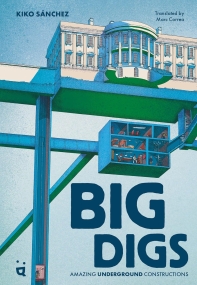
Big Digs: Amazing Underground Constructions

 
4.2 (2)
 
0.0 (0)
312 0
815+9t2CpqL
Co-Authors / Illustrators
Publisher
Age Range
8+
Release Date
May 05, 2026
ISBN
978-3039641246
Buy This Book
     
A fascinating book for young readers to discover 3,000 years of tunnels!
From ancient burial chambers to modern megaprojects, Big Digs is a beautifully illustrated nonfiction book that takes young readers on an unforgettable journey into the world beneath our feet, exploring the science, history, and wonder of underground construction. 

Travel through hidden passages beneath palaces, secret tunnels under cities, and engineering marvels like the Channel Tunnel and the Large Hadron Collider. Each spread reveals a new underground world with fun facts, vibrant artwork, and surprising stories from around the globe.

Packed with educational content and visual charm, Big Digs is perfect for curious kids who love history, science, or exploring the unknown. A captivating book that will open young minds to what lies beneath!

Editor reviews

2 reviews
interesting look at underground structures
(Updated: June 12, 2026)
Overall rating
 
4.3
Writing Style
 
4.0
Illustrations/Photos (if applicable)
 
5.0
Learning Value
 
4.0
BIG DIGS is an interesting look at underground structures that have been built over time and around the world. It begins with ancient structures in Cornwall where tunnels were made underground thousands of years ago through modern times and into ideas for life on Mars.

What I loved: Every page is fully illustrated and does a great job depicting the underground structures with lots of cool details. They provide a lot of clarity on what it looks like and how it is used. The accompanying text is conversational and easy to understand, answering the basic questions readers might have like how it was made or how it was used. The breadth of locations and times was great, giving a fantastic glimpse into history, architecture, and construction.

The book is very large, which makes it fun to lay out on the floor and explore. Some of the call-outs add contextual information about culture or the time that add to the fun and provide additional learnings that are fun.

What left me wanting more: As a small thing, some of the text is very small and can be hard to read on dark backgrounds. Younger eyes will have an easier time of it though. The information touches upon a lot of topics without going too much in-depth, so it may be a good platform to then find other books with more detail about specific topics of interest.

Final verdict: BIG DIGS is an interesting look into underground structures over time and the globe that will entertain curious middle grade readers with detailed illustrations and conversational text.
Comments (0) | Was this review helpful? 0 0
What lies beneath the surface
(Updated: June 12, 2026)
Overall rating
 
4.0
Writing Style
 
4.0
Illustrations/Photos (if applicable)
 
4.0
Learning Value
 
4.0
Who knew that there were so many underground tunnels, or that they were built over such a long period of time?! From prehistoric tunnels in Cornwall and ancient aqueducts to a Finnish nuclear waste repository built in 2004, this book describes a variety of different underground construction projects from all over the world.

Underground architecture is hard to depict, but Sánchez does a good job at showing cross sections of the buildings, which can't have been easy. I did appreciate that there was sometimes a building on the surface that was shown, when it has the entrances to the tunnels. Of course, now I really want to know how anyone was able to map out the tunnels under Dover Castle, although I'm not surprised that they were used as bunkers during World War II.

The variety of uses for these tunnels is interesting. There is the global seed vault in Svalbard, the Big Dig in Boston, and the Hadron Collider, which are all very official, but also Narcotunnels in Tijuana, tunnels under the Berlin Wall, and the very odd Quinta da Regaleira, a personal palace built by a man who was a Freemason. There is one underground installation that is no more: the Presidential Emergency Operations Center (PEOC) (1942-2001) that was destroyed in the fall of 2025.
Good Points
The drawings are very detailed, but the backgrounds are a bit dark, which makes it hard to read the text in some instances. This book is rather large, so would be hard for a student to put in a backpack. The paper over board covers that Helvetiq produces do not hold up to school library wear, but would be fine in a home setting.

Hand this to a budding architect along with Gargulakova and Bachorik's Bridges, Bartunek and Velcovsky's From Pyramids to Palaces and How the New Seven Wonders of the World Were Built, Theule and Light's Concrete: From the Ground Up, and Sedlackova and Konecna's Bustling Cities of the World.
Comments (0) | Was this review helpful? 0 0

User reviews

There are no user reviews for this listing.
Already have an account? or Create an account