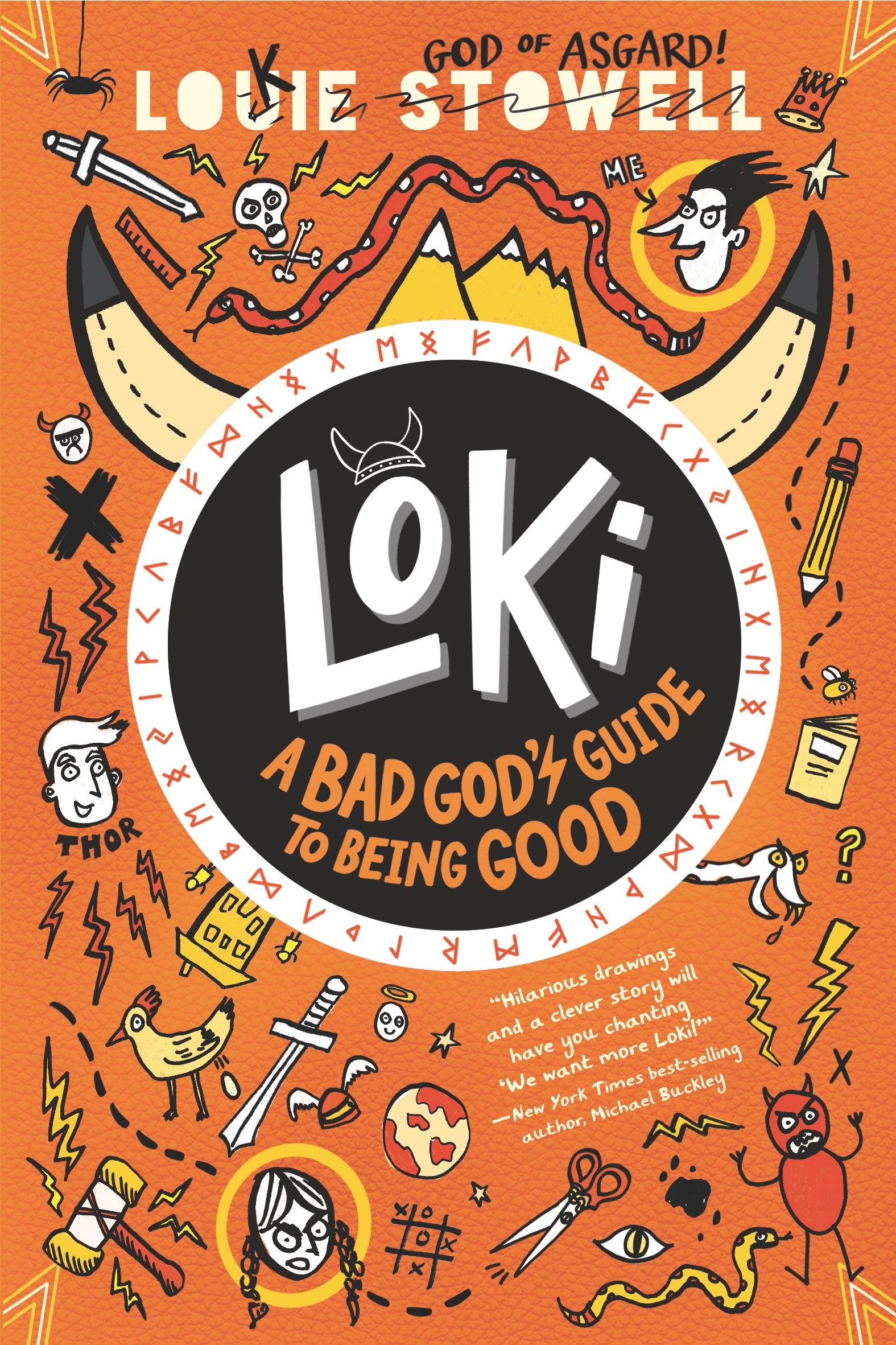
Today we are very excited to share an interview with Author, Louie Stowell (LOKI: A BAD GOD’S GUIDE TO BEING GOOD)
Meet the Author: Louie Stowell

Louie Stowell started her career writing carefully researched books about space, ancient Egypt, politics, and science, but eventually lapsed into just making stuff up. The author of the Kit the Wizard series, she was inspired by her research into Norse myths to write Loki: A Bad God’s Guide to Being Good, her first project as both author and illustrator. Louie Stowell writes full-time in London, where she lives with her wife, Karen; her dog, Buffy; and a creepy puppet that is probably cursed.
About the Book: LOKI: A BAD GOD’S GUIDE TO BEING GOOD
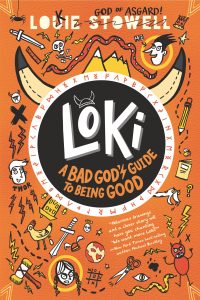
After one prank too many, trickster god Loki has been banished to live as a kid on Earth. If he can show moral improvement within one month, he can return to Asgard. If he can’t? Eternity in a pit of angry snakes. Rude! To keep track of Loki’s progress, King Odin (a bossy poo-poo head) gives him this magical diary in which Loki is forced to confess the truth, even when that truth is as ugly as a naked mole rat. To make matters worse, Loki has to put up with an eleven-year-old Thor tagging along and making him look bad. Loki is not even allowed to use his awesome godly powers! As Loki suffers the misery of school lunch, discovers the magic of internet videos, and keeps watch for frost giant spies, will he finally learn to tell good from bad, trust from tricks, and friends from enemies? Louie Stowell’s witty text and hysterical drawings will keep readers in stitches from start to finish.
Amazon * B&N * Indiebound
~Author Chat~
YABC: What gave you the inspiration to write this book?
Norse myths! They’re so wild and funny and full of eccentric characters. I’ve always loved mythology and grew up reading legends from around the world. I had a book of Norse myths with hyper-realistic pictures of the gods and monsters that stuck with me, then I came back to the myths as an adult. I was writing a book of retellings as part of my job as an in-house writer at a publisher and read various original texts. They were even stranger than I remembered! The character of Loki fascinated me in particular because I’ve always been drawn to liminal figures. I love that borderland between good and evil, and characters who are not just one thing. But as well as Norse myths, I also had other images in my mind: the archetypal naughty school child. I wanted a punishment for Loki, and becoming a schoolboy felt like the ultimate one, because he’s so proud and full of himself. Being forced to do chores and homework and have a set bedtime, that’s enough to make Loki FURIOUS. I think part of a writer’s real job is to make their characters suffer. Poor Loki.
YABC: Who is your favorite character in the book?
Loki’s probably the obvious answer but I’m also very fond of Heimdall, his fake dad. I remember watching Third Rock from the Sun as a kid and loving the idea of adults who don’t know how to be adults – in that show’s case, it’s because they’re aliens. Heimdall is a god who’s trying really hard to be a good dad to Loki, even though they’re usually enemies. He gets really into parenting books and cooks a lot.
YABC: Which came first, the title or the novel?
The novel. Loki has been through many, many titles. I believe the first one was something along the lines of “The 100% True Confessions of an 11-year-old God.” Once I had the title for book one, the brain-searching wasn’t over either. My editor and I came up with about 50 titles before we settled on the final book 2 title! My favourite title that we had to reject was a MASSIVE spoiler, for example.
YABC: What scene in the book are you most proud of, and why?
This is SUCH a great question! Usually, when I’ve finished a book, I don’t look back. I find it hard not to just see flaws. So I really welcome being prodded to look at it in the light of pride. I think it’s probably the moment that Valerie Kerry (Loki’s human friend) jumps to conclusions about Loki’s true nature. (I don’t know if the people reading this have read the book so don’t want to say too much!)
YABC: Thinking way back to the beginning, what’s the most important thing you’ve learned as a writer from then to now?
So, it’s been a LONG road for me. I started writing seriously right after university, in 2001. My first novel, The Dragon in the Library, was published in the UK in 2019. Perhaps the most important thing I’ve learned is that you need to find an internal motivation to write, because success is something you can never count on. The internal motivation for me is that particular joy you get from entering a fictional world and shaping it.
YABC: What’s a book you’ve recently read and loved?
I just read a proof of Onyeka and the Academy of the Sun by Tọlá Okogwu and it’s everything I wanted in a superhero story. Brilliantly-written mother-daughter relationship plus a superhero school and a girl with truly unique powers. Gripping and funny too! As an author I end up reading a lot of proofs, so trying to think of a book that’s actually OUT that I’ve enjoyed is a bit more of a struggle! So I end up taunting people with books that aren’t out for ages! This one’s out in June in the US and UK, so not THAT long to wait.
YABC: What’s up next for you?
I’m currently finishing off the art for Loki book 2, then about to get started on book 3. I am having so much fun exploring Loki’s world. Or rather, Loki’s plight in our world. Book 2 features a stolen hammer, while book 3 involves a cursed ring. One of the things I like best about writing these books is juxtaposing experiences from human childhood with mythological figures and plots. I often read ancient tales wondering what the heroes (and villains) from them would experience if they woke up in our world. Loki’s not visited earth in about a thousand years, so he’s having a bit of a Rip Van Winkle experience, being exposed to a millennium of change on earth – not all of it positive.
YABC: What is the main message or lesson you would like your reader to remember from this book?
The primary message – though Loki hates messages – is that no one is inherently good or bad. All that matters is what you do, not who or what you are. Writing a character like Loki was a great chance to explore fluidity – Loki is a person with no fixed gender, no fixed moral status, no fixed form. He’s also deeply morally ambiguous, so provides a useful lens to explore the idea of moral change. I’ve set the books after most of the myths have already happened, but they happen BEFORE he kills Balder and ushers in the end of the world in the myth cycle. That feels like a point at which he tips over from moral ambiguity to being a truly bad god. I wanted to capture him on the cusp of the potential for great villainy, so the stakes feel high enough. In the myths, he’s cursed to (almost) eternal punishment in a dungeon full of snakes after he kills Balder. So that’s hovering over his head in the background of my books. I really loved The Good Place and I’m very interested in the philosophical question of what makes a good person. Loki is learning that during the story… while also getting the wrong end of the stick a long time. My feeling about moral growth is that it involves a lot of mistakes and missteps.
The secondary message of the books is that you shouldn’t believe adults or systems! All power structures are a scam. There’s an “authoritative” voice in the book, of Odin. But I want readers to question that voice as well as Loki’s more obviously shady takes on things.
YABC: What would you say is your superpower?
Jokes. I find writing jokes quite easy.
YABC: What advice do you have for new writers?
Don’t be in too much of a hurry to get published. It’s a long game for so many people. And the longer you have to practice your writing before you’re published, the more chance you have of finding your true voice, and basing your career on that instead of on your first attempts. It took me about 20 years, and I’m not saying you have to wait that long. But there are definitely advantages to taking your time. I feel like I’m writing the books of my heart now.
Author: Louie Stowell
Release Date: 6/14/22
Publisher: Walker Books
Age Range: 9-12 years