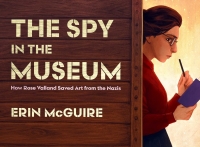
The Spy in the Museum: How Rose Valland Saved Art from the Nazis

71h-KO31LuL
Author(s)
Age Range
6+
Release Date
September 16, 2025
ISBN
978-1534466173
Buy This Book
     
This riveting, “visually stunning” (Kirkus Reviews, starred review) picture book biography tells the true story of Rose Valland’s valiant efforts to save thousands of works of art during World War II by becoming a spy in her own museum.

Rose Valland loved art. When the Nazis invaded Paris during World War II and took over her beloved museum, Rose could have fled. But who would save the artwork?

So, Rose remained and saw how she was underestimated by the soldiers for being a quiet, unassuming woman. She knew it was the time to act. And Rose had a secret weapon: she could speak German. She listened, kept track of all the stolen art, and saved what she could. Rose became a spy. And in the end, she saved thousands of works of art.

Editor review

1 review
Those also serve who keep good records!
(Updated: June 20, 2026)
Overall rating
 
5.0
Writing Style
 
5.0
Illustrations/Photos (if applicable)
 
5.0
Learning Value
 
5.0
Rose Valland was a curator at the Jeu de Paume museum in Paris before World War II, and when the Germans invaded the city in 1940, she was the only staff member left to manage the collection. She loved art, so was glad to stay behind, even though she was constantly at risk. The Nazis not only took art to sell to fund the war effort, but destroyed works that Hitler considered "degenerate". Rose was closely watched, so did the only thing she could; she documented everything she knew about the different works of art and where they were sent, cataloging over 20,000. At times, she was made to leave, but she always managed to get back into the museum to continue her work. She even worked with the French Resistance to stop the transport of a number of paintings. She couldn't save all of the paintings, but her efforts were useful. After the war, she worked with agencies trying to find art and restore it to its rightful owners, and reunited over 60,000 pieces. She was given France's Legion of Honor Award as well as the U.S. Medal of Freedom.
Good Points
The color palette of this book captures both the feeling of gloom under the Nazi occupation and the sense of an art museum with it's gold and brown tones that are similar to many picture frames. I loved the white on peach sketches of Paris on the end papers. The scenes of Paris often have a cinematic quality to them, but the renderings of the inside of the museum under Nazi occupation have a crowded, hectic quality to them. Young readers might not know much about World War II, but the pictures offer a feeling of what life was like at the time.

While this doesn't go into a lot of details about the war or the atrocities the Nazis committed, it does have a good message about doing what one can under perilous circumstances. It would have been nice to include a photograph of Valland, and this definitely left me wanting to read more about this interesting art curator.

There are a few books fictional books for middle grade and young adult readers that deal with art during World War II, like Cameron's Artifice, Konigsberg's The Mysterious Edge of the Heroic World, Hicks' The Dark Skies Mystery: A World War II Thriller, or Fitzgerald's Under the Egg, and even the nonfiction The Greatest Treasure Hunt in History: The Story of the Monuments Men by Edsel, but I haven't seen much for younger readers. There are a number of picture books about art and artists, and The Spy in the Museum is a great book to have in a gallery with other art related works like Paley and Tentler-Krylov's Love Is Hard Work: The Art and Heart of Corita Kent, Aloise's Dogs in Art: A Canine History of Art, MacColl and Chavarri's Lady of the Lines: How Maria Reiche Saved the Nazca Lines by Sweeping the Desert, and Rogers;s and Innerst's Joan Mitchell Paints a Symphony.
Comments (0) | Was this review helpful? 0 0

User reviews

There are no user reviews for this listing.
Already have an account? or Create an account