
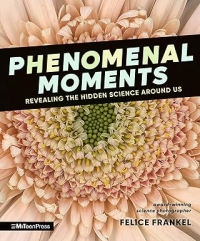
Enlisting readers to “be the scientist” through vivid fine-art photographs, internationally acclaimed science photographer Felice Frankel zooms in and out on beautiful and brilliant moments all around us to reveal the chemical, natural, or physical processes—from viscosity and venation to chlorophyll and capillary action—behind scientific phenomena. Organized into five thematic sections that explore light and shadow, form, surfaces, traces left behind, and transformation, this ingenious book is both a visual feast to savor in its own right and a guessing game that trains readers to look in a more layered, curious, and questioning way. Close-up spreads offer abstract clues to phenomena revealed at the page turn. Full-color images of similar scientific “moments” broaden context. Sophisticated and inspiring, this invitation to engage with and understand our surroundings—the worlds we can see and the worlds we can’t—is a ticket to everyday wonder.
- Books
- Middle Grade Non-Fiction
- Phenomenal Moments: Revealing the Hidden Science Around Us
Phenomenal Moments: Revealing the Hidden Science Around Us
Author(s)
Publisher
Genre(s)
Age Range
10+
Release Date
November 04, 2025
ISBN
978-1536234893
Buy This Book


Editor review
1 review
Surprising things we see every day
(Updated: June 15, 2026)
Overall rating
4.7
Writing Style
4.0
Illustrations/Photos (if applicable)
5.0
Learning Value
5.0
What worked:
The Amazon listing indicates that this book is for ages thirteen and older, but there’s no reason younger readers can’t enjoy it. Most of the concepts aren’t overly complex, so ages ten and above should be able to understand them. The book’s format encourages mental engagement by the readers. The author/photographer presents a photographic image and asks readers to guess what they’re seeing. Turning the page tells them the photo’s origin, and it’s followed by a paragraph explaining the science behind the various effects. The subjects change with every turn of a page, so the book moves at a swift pace. This facet of the book will appeal to readers at the younger end of the reading range.
Most of the illustrations are relatable to young readers. The first picture shows a close-up of overlapping fabrics accompanied by an explanation of how textile patterns were once produced. Other photographs show the effects of sunlight striking the surface of lakes or pools. Zooming in on the surface of a strawberry leads to information about pineberries and the definition of fruits. One picture displays a large drop of water, while other ones show condensation on glass or the effervescence of bubbles from a soft drink. There’s even a photo of the myriad of colors resulting from oil dripping onto a driveway. Young readers will be amazed when they discover the photographic wonder found in everyday experiences.
What didn’t work as well:
The information isn’t comprehensive enough for research, but it serves as a nice catalyst for further study. Some of the vocabulary is more advanced, such as hydrophobic, venation, and hydraulic jump, but the overall book is approachable to the ages mentioned earlier.
The final verdict:
The book’s format makes it entertaining for readers of all ages, and the scientific explanations aren’t intimidating. The brevity of the explanations creates a comfortable pace for reading, and the photographic images can be found around most neighborhoods. I recommend upper middle-grade readers give this book a shot.
The Amazon listing indicates that this book is for ages thirteen and older, but there’s no reason younger readers can’t enjoy it. Most of the concepts aren’t overly complex, so ages ten and above should be able to understand them. The book’s format encourages mental engagement by the readers. The author/photographer presents a photographic image and asks readers to guess what they’re seeing. Turning the page tells them the photo’s origin, and it’s followed by a paragraph explaining the science behind the various effects. The subjects change with every turn of a page, so the book moves at a swift pace. This facet of the book will appeal to readers at the younger end of the reading range.
Most of the illustrations are relatable to young readers. The first picture shows a close-up of overlapping fabrics accompanied by an explanation of how textile patterns were once produced. Other photographs show the effects of sunlight striking the surface of lakes or pools. Zooming in on the surface of a strawberry leads to information about pineberries and the definition of fruits. One picture displays a large drop of water, while other ones show condensation on glass or the effervescence of bubbles from a soft drink. There’s even a photo of the myriad of colors resulting from oil dripping onto a driveway. Young readers will be amazed when they discover the photographic wonder found in everyday experiences.
What didn’t work as well:
The information isn’t comprehensive enough for research, but it serves as a nice catalyst for further study. Some of the vocabulary is more advanced, such as hydrophobic, venation, and hydraulic jump, but the overall book is approachable to the ages mentioned earlier.
The final verdict:
The book’s format makes it entertaining for readers of all ages, and the scientific explanations aren’t intimidating. The brevity of the explanations creates a comfortable pace for reading, and the photographic images can be found around most neighborhoods. I recommend upper middle-grade readers give this book a shot.

User reviews
There are no user reviews for this listing.
Already have an account? Log in now or Create an account
Latest Additions


GET A YABC BUTTON!


We have all sorts of YABC buttons for your website. Grab one here and link to YABC!