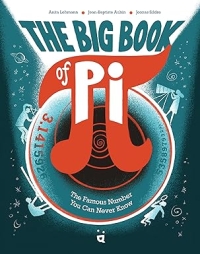
The Big Book of Pi

81Q4w00ParL
Co-Authors / Illustrators
Publisher
Age Range
8+
Release Date
February 03, 2026
ISBN
978-3039640898
Buy This Book
     
A Junior Library Guild Selection
A mathe-magician explores what makes Pi so intriguing, so unknowable and so very important to our lives. 
For millennia, humans have been obsessed with the number Pi. We needed it for architecture, geometry and astronomy, and so it was sought by the ancient Egyptians, the Mayans and the ancient Chinese. But no one has ever found it—and no one ever will because Pi is infinite and irrational. Its decimals contain the birthdates of all the children who have ever lived, every piece of music, the complete works of Shakespeare. Pi never ends and can’t be learned, but humans keep on trying. Today, we know trillions of decimals of Pi, even if the first fifteen are more than enough to send a rocket to Mars! 

Telling the story of Archimedes the Greek to Srinivasa Ramanujan the Indian (who saw in his dreams a formula for calculating Pi still used by computers today), via Arabs and mathematics enthusiasts from all over the world and all eras, The Big Book of Pi is an extraordinary adventure (almost) to infinity. 

Written by a mathe-magician with a Pi-passion, in these pages you’ll meet a man who memorized ten thousand digits—and get a chance to try yourself. You’ll read about a Pi paradox and a Pi magic trick and laugh at more Pi jokes than you ever thought you’d hear. We can’t ever know Pi, but there sure is a lot to learn!

Editor review

1 review
The history of Pi
(Updated: June 04, 2026)
Overall rating
 
4.0
Writing Style
 
4.0
Illustrations/Photos (if applicable)
 
4.0
Learning Value
 
4.0
What worked:
All middle-grade readers have heard of Pi, but the only thing they probably know is that it equals 3.14. This book takes readers back to the creation of the concept and describes its evolution over the years. Why is it called Pi and not something else? Mathematicians throughout history have tried to understand Pi and calculate its value as exactly as possible. The fact that its value is infinite and non-repeating means no one can ever find an exact number. The book shares different strategies used by ancient Egyptians and Babylonians, Archimedes, and other people around the world. Some pages apply the concept to calculate values related to curved objects and solve mathematical questions.
The book is loaded with colorful illustrations and diagrams to help readers understand Pi. The diagrams are helpful when explaining strategies and applying them to solve problems. Definitions of mathematical terms are found at the bottom of the pages where they’re used and at the back of the book. “Fun facts” and other interesting information can also be found at the bottom of some pages. Did you know Pi Day is celebrated on March 14 (3/14)? A couple of pages share a Pi-related “magic” trick and Pi-related jokes. The official creatures of Pi Day are octopi.
What didn’t work as well:
Describing the methods people used to calculate the value of Pi becomes redundant. It’s interesting, but there’s a limit to the attention span of young readers. A redeeming factor is that the authors have a sense of humor, so the narrative is light-hearted and fun.
The final verdict:
This book is most appropriate for upper middle-grade readers. It won’t appeal to the general audience, but I recommend it to readers with a love for math. Dare I say math nerds?
Comments (0) | Was this review helpful? 0 0

User reviews

There are no user reviews for this listing.
Already have an account? or Create an account