
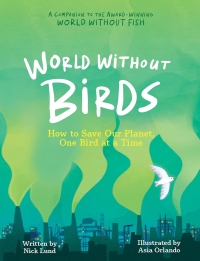
World Without Birds: How to Save our Planet, One Bird at a Time

71fHoLGwXpL
Author(s)
Co-Authors / Illustrators
Publisher
Age Range
10+
Release Date
March 03, 2026
ISBN
978-1523518029
Buy This Book
     
This follow-up to the celebrated World Without Fish will awaken readers to the extraordinary beauty and uniqueness of birds, the monumental challenges to their survival—and what humans can do to help.

"This is a book about hope."

If you look out the window, chances are high you'll spot a bird soaring in the sky or perched on a tree. Nearly 100 million Americans spend time birdwatching every year. Birds provide beauty, pollination, pest control, waste management, a food source, recreation, cultural enrichment, and many other functions important to human life and environmental balance ...

... and now they're disappearing at ever greater rates, thanks to climate change, habitat destruction, and invasive species, among other causes. Written by an acclaimed journalist associated with the Audubon Society, World Without Birds examines the many factors contributing to this devastating loss and what our planet would look like in birds' absence. Organized by ecosystem, each chapter offers an overview of the birds in that environment, then case studies of both one avian species that has gone extinct and one whose numbers have recovered, balancing honesty and optimism for readers of all ages. The final chapter suggests actions that bird lovers can take to help preserve avian lives and habitats. Filled with gorgeous, colorful pictures, including richly illustrated bird guides for each ecosystem, World Without Birds shares a hidden true story of danger, discovery, and hope.

Editor review

1 review
Informative Book About Birds
(Updated: June 06, 2026)
Overall rating
 
4.3
Writing Style
 
4.0
Illustrations/Photos (if applicable)
 
5.0
Learning Value
 
4.0
World Without Birds is an informative book that highlights what factors contribute to the loss of birds and what the planet would look like if we had no birds. This book is organized by exosystems, and each chapter provides an overview of the birds in that environment, case studies on a specific bird species that is now extinct, and one that was on the verge of extinction but numbers recovered, and additional information about what the world would look like minus those birds. The end chapter highlights things that we can do to help preserve bird lives and their habitats.

What I Liked: This book begins with an explanation about how it's going to be about hope, stupidity, greed, ignorance, love, and more, while explaining how this book will go through each of these various emotions. The introduction for this book does a great job of laying the foundation for the rest of the book so that you have an understanding of what’s to come.

Prior to going into the various ecosystems that birds live in, the book talks about the world with birds and without them, and the ways humans are contributing to their extinction. These chapters are full of information and do a fantastic job of painting the landscape of how we are damaging the earth. When we begin to go into the individual ecosystems, the book highlights the birds in that environment, and what the environment would look like without those birds. These sections are great for exploring the role that birds play in different areas, such as The Poles and Tropical forests, and how those would be impacted if those birds were extinct.

The book is full with colorful illustrations that are spread out through the text. The illustrations are good for creating natural pauses in the sections and giving visual explanations for the phenomena that are being explored. In addition to the illustrations, this book also includes various headers for the sections using larger font and different colors, which help break the chapters into approachable sections for younger readers.

Final Verdict: World Without Birds is an informative book with colorful and vibrant illustrations that showcase the important role that birds have in various ecosystems, and what life would look like if those birds were extinct. This book is great for children ages 10 and up who are interested in birds and sustainability. The book also works great for adults who want to explore the world of birds and want to learn how to keep birds and their habitats intact.
Comments (0) | Was this review helpful? 0 0

User reviews

1 review
Overall rating
 
4.7
Writing Style
 
5.0(1)
Illustrations/Photos (if applicable)
 
4.0(1)
Learning Value
 
5.0(1)
Already have an account? or Create an account
Great informational read!
(Updated: June 06, 2026)
Overall rating
 
4.7
Writing Style
 
5.0
Illustrations/Photos (if applicable)
 
4.0
Learning Value
 
5.0
World Without Birds was surprisingly an engaging nonfiction book that really makes you stop and think about how much birds matter. Instead of just listing facts, the book walks through different ecosystems and shows what birds actually do in those environments, and what happens when they disappear. It doesn’t just focus on loss either, it balances things by showing species that have already gone extinct alongside ones that have been saved, which makes it feel more real and less hopeless. You start to realize that birds aren’t just “nice to look at,” they play a huge role in keeping nature working the way it should.

What I liked most is how the book is set up in a way that doesn’t feel overwhelming. The sections are broken up clearly, and the illustrations help a lot with understanding what’s being explained. It’s the kind of book where you can read a chapter at a time and still learn something meaningful without feeling lost. I also appreciated that it explains human impact in a very direct way. It doesn’t sugarcoat things, but it also doesn’t make you feel like nothing can be done. My favorite parts were the comparisons between ecosystems with birds and without them, because it really shows how quickly things can fall apart without us even noticing.

I think this is a great educational book, especially for middle school readers and up, but honestly a lot of adults could learn from it too. It’s not just about birds, it’s about understanding how connected everything is and how small actions can actually make a difference. One thing I didn’t expect is how motivating it would feel by the end. The final sections give simple ways people can help, which makes the book feel useful instead of just informative. It’s the kind of book that makes you look outside a little differently and actually pay attention to what’s there.
Good Points
Clear explanations that make environmental topics easier to understand

Real examples of both loss and recovery that keep it balanced

Encourages small actions readers can take to help protect wildlife
Comments (0) | Was this review helpful? 0 0